Research Use Only. VIP is sold as a chemical reagent for in-vitro laboratory research. It is not a drug, supplement, or compounded preparation, and it is not for human or veterinary use. It must be handled by qualified professionals. Wholesale Peptide Supply is not a pharmacy or compounding facility under 503A or 503B.
Wholesale VIP — Bulk Research Supply
Buy VIP wholesale and in bulk from a US-based research peptide supplier. Every lot is sourced in the USA and third-party tested via HPLC/MS. Bulk VIP is quoted by dose and volume from a 100-vial mix-and-match minimum; volume pricing is earned per compound at 100 kits.
Vasoactive Intestinal Peptide is a 28-residue basic neuropeptide of the secretin/glucagon superfamily, studied as a VPAC1/VPAC2 receptor agonist in laboratory models of vascular, immune and neuroendocrine signaling.
Wholesale Catalog
Available Doses
Published per-vial wholesale pricing for VIP. Sold in kits of 10 vials with a 100-vial order minimum you can mix and match across compounds; volume pricing applies at 1,000+ vials. Contact us for larger or custom-volume quotes — typically answered within 10 minutes during business hours.
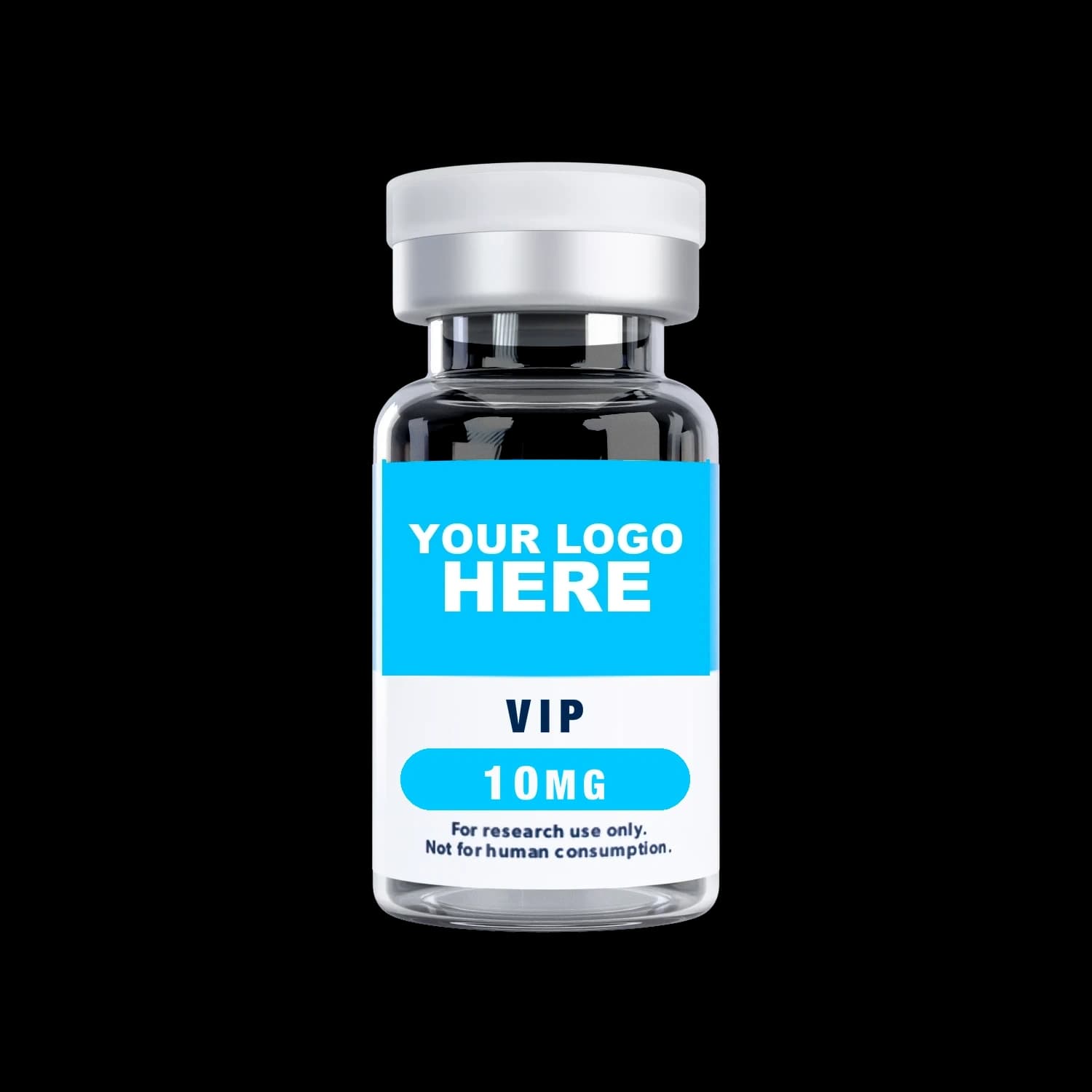
VIP 10mg50% off
WPSVS10 · CAS 37221-79-7 · Immune & Inflammatory
$28.46$14.23/vial · 50% off at any volumeWhile supplies last
Discontinued — limited to stock on hand. Once it's gone, it's gone. Sold in kits of 10 vials · 100-vial order minimum (mix & match across compounds).
Overview
Vasoactive Intestinal Peptide is a 28-residue basic neuropeptide of the secretin/glucagon superfamily, studied as a VPAC1/VPAC2 receptor agonist in laboratory models of vascular, immune and neuroendocrine signaling.
History
Isolated from porcine intestine by Said and Mutt in 1970 and later shown to be widely distributed in neural tissue, VIP became a reference ligand for the VPAC receptor family and a common subject of anti-inflammatory signaling research.
VPAC1 and VPAC2 are what make VIP broad
VIP is unusual among the peptides in this catalog in how widely its receptors are distributed. VPAC1 and VPAC2 are class B G-protein-coupled receptors of the secretin/glucagon family, and they are expressed across vascular smooth muscle, lymphocytes and macrophages, gut and airway epithelium, and the suprachiasmatic nucleus. A single 28-residue ligand therefore shows up in vascular, immune, gastrointestinal and circadian work at once.
That breadth is the reason VIP appears in such different literatures, and it is also the reason experimental design matters more here than with a narrowly targeted peptide. Receptor subtype selectivity is poor — native VIP binds VPAC1 and VPAC2 with broadly comparable affinity — so work that needs one and not the other generally reaches for a subtype-selective analog rather than the native sequence. Studies using native VIP are usually asking what the combined signal does in a given tissue.
Supplied lyophilized; stored at -20°C protected from light, reconstituted solution refrigerated at 2-8°C and used promptly. General reagent handling guidance only; not for human or veterinary use.
Certificates of Analysis
2 certificates are on file for VIP — open any one to read the full report.
| Lot | Dose | Tested | Certificate |
|---|---|---|---|
| DPS-2920840 | 10mg | 2026-09-14 | |
| 100089-0964 | 10mg | 2026-08-20 |
Key Areas of Research
- VPAC1 / VPAC2 receptor binding
- Vasodilatory and smooth-muscle signaling models
- Immune modulation and cytokine dynamics
- Circadian and neuroendocrine research
References
- Said S.I. & Mutt V. (1970). Polypeptide with broad biological activity: isolation from small intestine. Science, 169(3951):1217–1218.
- Delgado M. & Ganea D. (2013). Vasoactive intestinal peptide: a neuropeptide with pleiotropic immune functions. Amino Acids, 45(1):25–39.
VIP — Frequently Asked Questions
- What is VIP?
- Vasoactive Intestinal Peptide is a 28-residue basic neuropeptide of the secretin/glucagon superfamily, studied as a VPAC1/VPAC2 receptor agonist in laboratory models of vascular, immune and neuroendocrine signaling.
- What is the CAS number for VIP?
- The CAS number for VIP is 37221-79-7. Its molecular formula is C₁₄₇H₂₃₇N₄₃O₄₃S (MW 3,325.8 g/mol).
- What doses of VIP are available wholesale?
- Wholesale Peptide Supply stocks VIP in 10mg. Wholesale pricing is provided by quote based on order volume across 100–1,000 vials.
- Is VIP third-party tested?
- Yes. Every lot of VIP is tested by an independent third-party laboratory using HPLC/MS, and a per-lot Certificate of Analysis documenting identity and purity is included with every order at no charge, issued in the name of Wholesale Peptide Supply.
- Is VIP for human use?
- No. VIP is sold strictly as a chemical reagent for in-vitro laboratory research and is not for human or veterinary use. Wholesale Peptide Supply is not a pharmacy or compounding facility.
- How do I get wholesale pricing for VIP?
- Request a quote through our contact form or open a wholesale account. An account manager replies with volume pricing and lead times, typically within 10 minutes during business hours.
- Can I order VIP in bulk?
- Yes. VIP is available for bulk and wholesale orders, quoted by dose and volume, with the lower price earned per compound at 100 kits (1,000 vials). Submit the doses and quantities you need for a bulk quote.
Related Compounds
Immune & Inflammatory
KPV
KPV is a small tripeptide derived from the C-terminus of α-MSH studied for cytokine signaling, NF-κB modulation, and epithelial barrier dynamics.
View details →Immune & Inflammatory
LL-37
LL-37 is the only known human cathelicidin peptide, a 37-residue amphipathic helix studied in laboratory models of antimicrobial activity, epithelial signaling and innate immune modulation.
View details →GLP-1 & Metabolic
Semaglutide
Semaglutide is a synthetic peptide analog that functions as a long-acting pathway agonist, structurally modified for extended half-life and improved target binding affinity. It is studied in preclinical and laboratory models for its ability to activate target pathways and modulate downstream molecular signaling associated with endocrine regulation.
View details →GLP-1 & Metabolic
Tirzepatide
Tirzepatide is a synthetic peptide that functions as a dual pathway agonist, designed as a once-weekly investigational compound studied in preclinical laboratory models for receptor-mediated signaling and modulation of downstream cascades.
View details →GLP-1 & Metabolic
Retatrutide
Retatrutide is a synthetic investigational peptide developed as a multi-pathway agonist, representing the next generation of metabolic research compounds. It activates multiple target receptor subtypes for broad systemic effects studied in preclinical models.
View details →Growth Hormone
Ipamorelin
Ipamorelin is a synthetic pentapeptide and selective secretagogue-type agonist with minimal off-target pathway interference, used to study endocrine signaling and somatotroph axis modulation.
View details →Recovery & Structural
BPC-157
BPC-157 is a synthetic pentadecapeptide composed of 15 amino acids, originally derived from a naturally occurring protein fragment in gastric tissue. It has been studied extensively for its potential influence on molecular signaling, structural remodeling, and angiogenic processes.
View details →Anti-Aging & Longevity
GHK-Cu
GHK-Cu is a naturally occurring copper-binding tripeptide studied for its role in molecular signaling, matrix remodeling, and pathway dynamics.
View details →