Research Use Only. GLOW Blend is sold as a chemical reagent for in-vitro laboratory research, not for human or veterinary use. It is not a drug, supplement, or compounded preparation. It must be handled by qualified professionals. Wholesale Peptide Supply is not a pharmacy or compounding facility under 503A or 503B.
Wholesale GLOW Blend — Bulk Research Supply
Available sizes
In-stock orders ship same day when paid by 1 pm PT, Mon–Fri. Overnight available.
Buy GLOW Blend wholesale and in bulk from a US-based research peptide supplier. Every lot is sourced in the USA and third-party tested, with the lab and method on each lot's certificate. Bulk GLOW Blend is quoted by dose and volume from a 3-kit (30-vial) order minimum, mix and match across doses and compounds; lower prices are earned at 10 kits and again at 100 kits in the order, mix and match.
The GLOW Blend combines GHK-Cu, BPC-157, and TB-500 in a single research formulation, studied across structural, epithelial, vascular, and systemic models.
Wholesale Catalog
Available Doses
Published per-vial wholesale pricing for GLOW Blend. Sold in kits of 10 vials with a 3-kit (30-vial) order minimum, mix and match across doses and compounds; lower prices apply at 10 kits and at 1,000+ vials in the order. Contact us for larger or custom-volume quotes — answered the same day. Urgent? Text or call (714) 625-9215 — you’ll reach a real person in the United States, not a chatbot or an overseas call center.
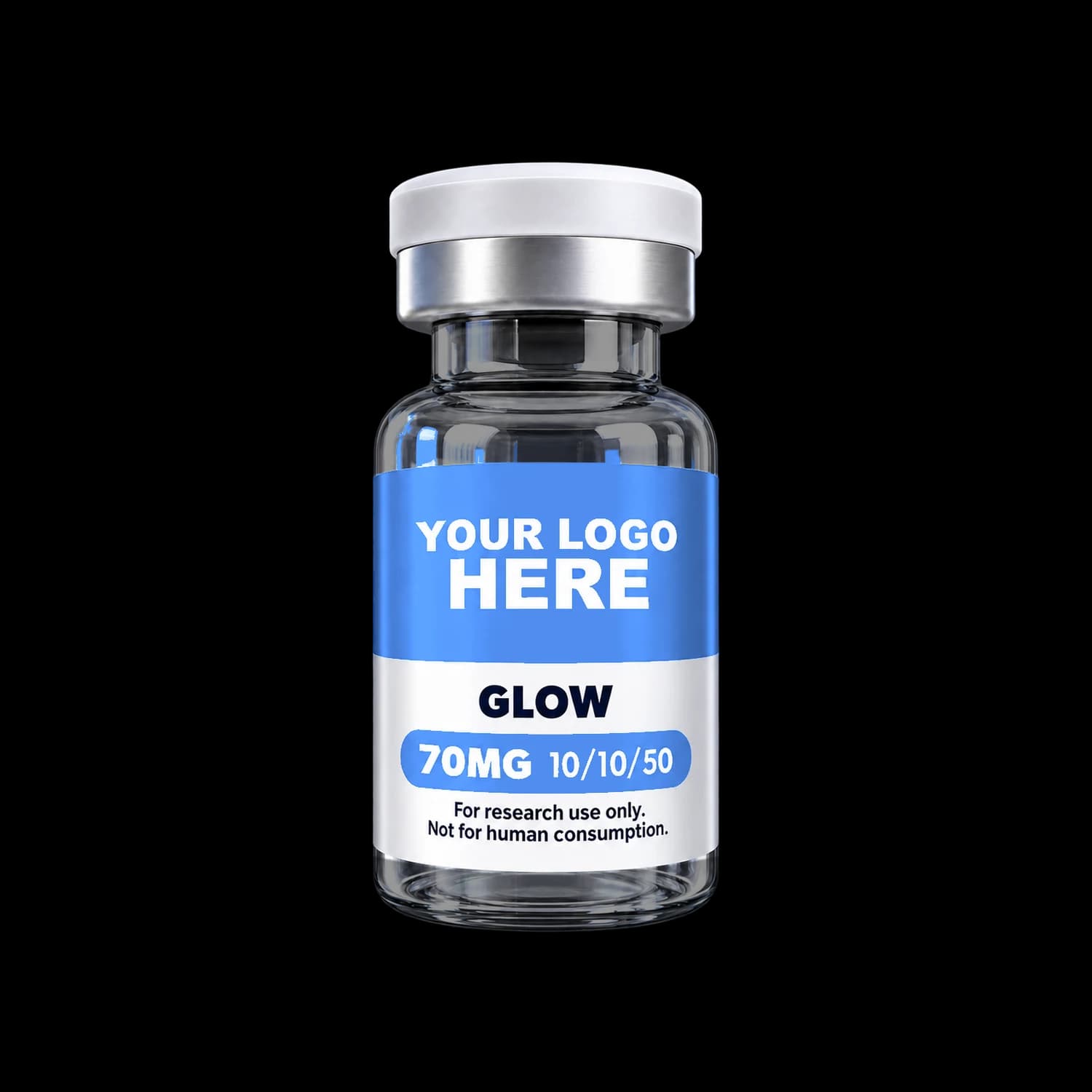
GLOW Blend 70mg (10/10/50)
WPSGW70 · CAS Multi-component · Custom Blends
- 1–9 kits
- $44.56/vial$40.10 paying by card
- 10–99 kits
- $35.64/vial$32.08 paying by card
- 100+ kits
- $28.52/vial$25.66 paying by card
10% off with card Every product, every volume band — taken off at checkout when you choose card.
Sold in kits of 10 vials · 3-kit order minimum, mix and match · price set by the total kits in your order (BAC water not counted)
Questions? Text a rep or call (714) 625-9215 — a real person in the US answers.
Overview
The GLOW Blend combines GHK-Cu, BPC-157, and TB-500 in a single research formulation, studied across structural, epithelial, vascular, and systemic models.
History
Combines three well-characterized peptides engaging complementary matrix and signaling pathways.
GLOW and KLOW: what separates them
GLOW and KLOW are one letter apart and are routinely confused at the point of ordering, so it is worth stating plainly: KLOW is GLOW with KPV added.
GLOW is a three-component formulation — GHK-Cu, BPC-157 and TB-500, 70 mg total in a 10/10/50 split. KLOW carries those same three components at the same strengths and adds 10 mg of KPV, giving 80 mg across four. Everything in GLOW is also in KLOW.
That makes them poor substitutes for one another in any design that cares about attribution. GLOW's research areas are structural, matrix and vascular signalling. KLOW layers cytokine and NF-κB modulation on top of that same base through its KPV component, which introduces an immune-signalling variable GLOW does not carry. Work that wants the structural base without that variable is GLOW; work that wants both in one preparation is KLOW. They are stocked and priced as separate SKUs.
What is in a GLOW vial, milligram by milligram
A GLOW vial holds 70 mg of peptide in three components: 50 mg of GHK-Cu, 10 mg of BPC-157 and 10 mg of TB-500. The "10/10/50" in the listing refers to those amounts, and GHK-Cu is the 50 mg component.
By mass GHK-Cu is five times either partner, but counted in molecules the gap is far wider. PubChem lists free GHK at 340.38 g/mol and its 1:1 copper complex at 401.91 g/mol, while BPC-157 is 1,419.6 g/mol. Fifty milligrams of GHK-Cu is therefore roughly 124–147 µmol against about 7 µmol of BPC-157: some 18 to 21 GHK-Cu molecules for every BPC-157 molecule in the vial, depending on whether the copper is counted. A design that normalizes by molar concentration rather than by mass has to account for that skew.
The ratio is fixed when the vial is made. A protocol that needs to vary one component on its own, such as titrating GHK-Cu while holding BPC-157 constant, cannot do it from GLOW; GHK-Cu, BPC-157 and TB-500 are each stocked as single compounds for that kind of work.
Three unrelated origins in one GLOW formulation
None of GLOW's components was discovered with the others in mind. GHK (Gly-His-Lys) was reported by Loren Pickart and Martin Thaler in 1973 (Nature New Biology 243:85–87) as a tripeptide in human serum that prolonged survival of liver cells in culture. BPC-157 was described by Predrag Sikirić's group in Zagreb in 1993 (Peptides 14:127–131) as a 15-residue partial sequence of a gastric juice protein. TB-500 is the synthetic component associated with thymosin β4, the actin-sequestering protein characterized by Allan Goldstein's group.
GLOW is a formulation convention rather than a molecule with its own literature. A PubMed search turns up no peer-reviewed study of this three-component, 50/10/10 mg mixture. The closest published work covers two of the three: Biçer and colleagues (Joint Diseases and Related Surgery, 2026) compared BPC-157, TB-500 and the two combined in a rat Achilles tendon transection-and-repair model over four weeks. TB-500 alone reached statistical significance for maximum load to failure against controls; total Movin histology scores were significantly lower in the TB-500 and combined groups; and the authors reported that the combination produced no additional effect beyond either peptide alone, describing the study as exploratory. GHK-Cu was not part of that design.
The GLOW certificates on file
Two GLOW lots have certificates on this page: lot 100032-0324, tested July 29, 2026, and lot 100089-0931, tested August 20, 2026. Both were tested by Optiq Health Labs, and both are recorded with the method RP-HPLC / LC-MS.
A blend certificate is read differently from a single-compound one. The point to check on any GLOW certificate is that it names all three components and reports an amount for each, rather than a single figure for the whole vial, because a three-part mixture can hit its total mass with one component short.
Certificates of Analysis
2 certificates are on file for GLOW Blend — open any one to read the full report.
| Lot / Lab | Dose | Tested | Purity | Certificate |
|---|---|---|---|---|
| 100089-0931Optiq Health LabsRP-HPLC / LC-MS | 70mg | 2026-08-20 | — | |
| 100032-0324Optiq Health LabsRP-HPLC / LC-MS | 70mg | 2026-07-29 | — |
Key Areas of Research
- Collagen, matrix, tendon/ligament
- Epithelial migration, follicle dynamics
- Angiogenesis, nitric oxide
References
- Pickart L. et al. (2015). BioMed Res Int.
- Sikiric P. et al. (1993). Peptides.
- Smart N. et al. (2007). Nature 445:177–182.
GLOW Blend — Frequently Asked Questions
- What is GLOW Blend?
- The GLOW Blend combines GHK-Cu, BPC-157, and TB-500 in a single research formulation, studied across structural, epithelial, vascular, and systemic models.
- What doses of GLOW Blend are available wholesale?
- Wholesale Peptide Supply stocks GLOW Blend in 70mg (10/10/50). Wholesale pricing is provided by quote based on order volume, from a 3-kit (30-vial) order minimum, mix and match across doses and compounds.
- Is GLOW Blend third-party tested?
- Yes. Every lot of GLOW Blend is tested by an independent third-party laboratory, and a per-lot Certificate of Analysis is included with every order at no charge, issued in the name of Wholesale Peptide Supply. The most recent published lot, 100089-0931 (70mg), was tested by Optiq Health Labs on 20 August 2026 by RP-HPLC / LC-MS. Every lot on file is listed with its certificate on this page.
- Is GLOW Blend for human use?
- No. GLOW Blend is sold strictly as a chemical reagent for in-vitro laboratory research and is not for human or veterinary use. Wholesale Peptide Supply is not a pharmacy or compounding facility.
- How do I get wholesale pricing for GLOW Blend?
- Request a quote through our contact form or open a wholesale account. An account manager replies with volume pricing and lead times the same day. For anything urgent, text or call (714) 625-9215 to reach a real person in the US.
- Can I order GLOW Blend in bulk?
- Yes. GLOW Blend is available for bulk and wholesale orders, quoted by dose and volume, from a 3-kit (30-vial) order minimum, mix and match across doses and compounds, with lower prices at 10 kits and at 100 kits (1,000 vials) in the order. Submit the doses and quantities you need for a bulk quote.
- What is in the GLOW blend, and at what ratio?
- Each 70 mg GLOW vial contains 50 mg of GHK-Cu, 10 mg of BPC-157 and 10 mg of TB-500, a 5:1:1 ratio by mass. Because GHK-Cu is a small tripeptide-copper complex, the molar ratio is far more lopsided: there are roughly 18 to 21 GHK-Cu molecules for every BPC-157 molecule in the vial.
- Has the GLOW combination itself been studied?
- No peer-reviewed study of this exact three-component, 50/10/10 mg mixture has been identified; the published literature is on the individual peptides. The nearest work is a 2026 rat Achilles tendon study by Biçer and colleagues comparing BPC-157, TB-500 and the pair, which reported no additional effect from combining them. GHK-Cu was not tested in that study.
- What is the difference between GLOW and buying GHK-Cu, BPC-157 and TB-500 separately?
- GLOW fixes the three at 50/10/10 mg in one vial, made as one lot under one certificate. Buying the single compounds lets a protocol set its own ratio, vary one component at a time, and run single-peptide controls, none of which a fixed blend allows. All three components are also stocked individually.
- Which GLOW lots have certificates on file?
- Two: lot 100032-0324, tested July 29, 2026, and lot 100089-0931, tested August 20, 2026. Both were tested by Optiq Health Labs using RP-HPLC / LC-MS, and both certificates are listed on this page.
Related Compounds
Custom Blends
KLOW Blend
The KLOW Blend extends the GLOW formulation with the addition of KPV, adding cytokine-modulating and immune signaling properties to the structural and vascular base blend.
View details →Custom Blends
Cagrilintide / Semaglutide Blend
A dual-agent research formulation pairing cagrilintide, a long-acting amylin analog, with semaglutide, a long-acting GLP-1 receptor agonist. Studied in laboratory models where amylin and incretin pathway signaling are examined together.
View details →Custom Blends
Retatrutide / Cagrilintide Blend
A dual-agent research formulation pairing retatrutide, a triple-pathway receptor agonist, with cagrilintide, a long-acting amylin analog. Studied where triple-agonist and amylin pathway signaling are examined together.
View details →Custom Blends
Semax / Selank Blend
A research formulation pairing Semax, an ACTH(4-10) analog, with Selank, a tuftsin analog. Both are Russian-developed regulatory peptides and are frequently studied side by side in neuropeptide research.
View details →GLP-1 & Metabolic
Semaglutide
Semaglutide is a synthetic peptide analog that functions as a long-acting pathway agonist, structurally modified for extended half-life and improved target binding affinity. It is studied in preclinical and laboratory models for its ability to activate target pathways and modulate downstream molecular signaling associated with endocrine regulation.
View details →GLP-1 & Metabolic
Tirzepatide
Tirzepatide is a synthetic peptide that functions as a dual pathway agonist, designed as a once-weekly investigational compound studied in preclinical laboratory models for receptor-mediated signaling and modulation of downstream cascades.
View details →GLP-1 & Metabolic
Retatrutide
Retatrutide is a synthetic investigational peptide developed as a multi-pathway agonist, representing the next generation of metabolic research compounds. It activates multiple target receptor subtypes for broad systemic effects studied in preclinical models.
View details →Secretagogue Peptides
Ipamorelin
Ipamorelin is a synthetic pentapeptide and selective secretagogue-type agonist with minimal off-target pathway interference, used to study endocrine signaling and somatotroph axis modulation.
View details →