Research Use Only. KLOW Blend is sold as a chemical reagent for in-vitro laboratory research, not for human or veterinary use. It is not a drug, supplement, or compounded preparation. It must be handled by qualified professionals. Wholesale Peptide Supply is not a pharmacy or compounding facility under 503A or 503B.
Wholesale KLOW Blend — Bulk Research Supply
Available sizes
In-stock orders ship same day when paid by 1 pm PT, Mon–Fri. Overnight available.
Buy KLOW Blend wholesale and in bulk from a US-based research peptide supplier. Every lot is sourced in the USA and third-party tested, with the lab and method on each lot's certificate. Bulk KLOW Blend is quoted by dose and volume from a 3-kit (30-vial) order minimum, mix and match across doses and compounds; lower prices are earned at 10 kits and again at 100 kits in the order, mix and match.
The KLOW Blend extends the GLOW formulation with the addition of KPV, adding cytokine-modulating and immune signaling properties to the structural and vascular base blend.
Wholesale Catalog
Available Doses
Published per-vial wholesale pricing for KLOW Blend. Sold in kits of 10 vials with a 3-kit (30-vial) order minimum, mix and match across doses and compounds; lower prices apply at 10 kits and at 1,000+ vials in the order. Contact us for larger or custom-volume quotes — answered the same day. Urgent? Text or call (714) 625-9215 — you’ll reach a real person in the United States, not a chatbot or an overseas call center.
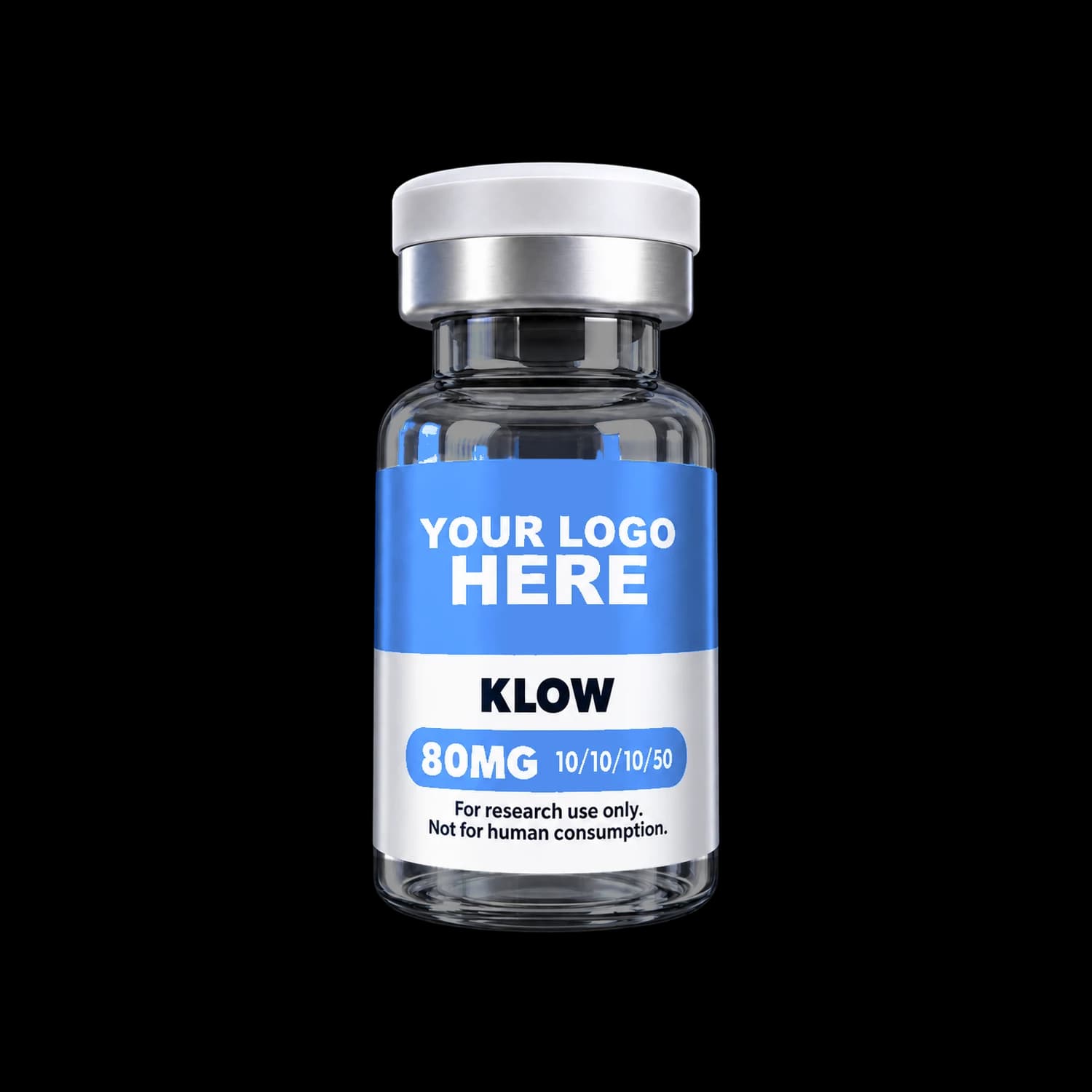
KLOW Blend 80mg (10/10/10/50)
WPSKW80 · CAS Multi-component · Custom Blends
- 1–9 kits
- $49.59/vial$44.64 paying by card
- 10–99 kits
- $39.68/vial$35.71 paying by card
- 100+ kits
- $31.74/vial$28.57 paying by card
10% off with card Every product, every volume band — taken off at checkout when you choose card.
Sold in kits of 10 vials · 3-kit order minimum, mix and match · price set by the total kits in your order (BAC water not counted)
Questions? Text a rep or call (714) 625-9215 — a real person in the US answers.
Overview
The KLOW Blend extends the GLOW formulation with the addition of KPV, adding cytokine-modulating and immune signaling properties to the structural and vascular base blend.
History
Combines four research peptides for combined structural/vascular/immune models.
KLOW and GLOW: what separates them
KLOW and GLOW differ by one letter in the name and by one component in the vial. KLOW is GLOW with KPV added.
GLOW is GHK-Cu, BPC-157 and TB-500 — 70 mg in a 10/10/50 split. KLOW holds those same three at the same strengths plus 10 mg of KPV, for 80 mg across four components. Nothing in GLOW is absent from KLOW.
The added KPV is the whole reason to choose KLOW: it brings cytokine modulation and NF-κB dynamics alongside the structural, matrix and vascular signalling the shared base already provides. If a model is examining the structural base on its own, the extra component is an uncontrolled variable and GLOW is the correct order. If the immune arm is wanted in the same preparation, KLOW is. Ordering one in place of the other changes what is in the vial, not just the price.
What is in a KLOW vial: four components, two of them tripeptides
A KLOW vial holds 80 mg across four components: 50 mg of GHK-Cu, 10 mg of BPC-157, 10 mg of TB-500 and 10 mg of KPV. GHK-Cu makes up 62.5% of the vial by mass and each of the other three 12.5%. Two of the four are tripeptides, and both contain lysine: GHK is Gly-His-Lys and KPV is Lys-Pro-Val. The similarity stops there. GHK was reported by Pickart and Thaler in 1973 as a copper-binding tripeptide in human serum; KPV is residues 11–13 of α-melanocyte-stimulating hormone, the C-terminal fragment Hiltz and Lipton (FASEB Journal, 1989) reported as active in a mouse ear-swelling model.
Counted by molecules rather than milligrams, KPV matters more than its share of the vial suggests. At under 400 g/mol, 10 mg of KPV is more than 25 µmol, over three times the roughly 7 µmol in the 10 mg of BPC-157 beside it. Although KPV is one-eighth of the vial by mass, it is the second most abundant component by molecule count, behind only GHK-Cu at roughly 124–147 µmol. Put together, the two tripeptides account for roughly nine in every ten peptide molecules in a KLOW vial, while BPC-157 and TB-500 supply most of the larger-molecule chemistry.
No peer-reviewed study of this four-component mixture has been identified. The KPV literature, including the PepT1 transport work of Dalmasso and colleagues (Peptides, 2008), concerns KPV on its own.
Reading the three KLOW certificates on file
Three KLOW lots have certificates on this page, from two laboratories, and they do not report the same things.
Lot 100057-0608 was tested by Optiq Health Labs on August 5, 2026 by RP-HPLC / LC-MS. Lot DPS-8846635 was tested by Horizon Analytical on October 1, 2026 by UPLC/MS, and it reports purity component by component: BPC-157 99.32%, TB-500 99.32%, GHK-Cu 99.65% and KPV 99.21%, with endotoxin below 0.05 EU/mL on a separate endotoxin certificate. Lot NHS-KLW80-20260915-01 was tested by Optiq Health Labs on October 5, 2026 by RP-HPLC / LAL, and reports a single purity for the blend, 99.8%, with endotoxin recorded as Pass (≤0.05 EU/mg).
Two practical points follow. The two endotoxin results are expressed in different units, per mL and per mg, so they are not directly comparable. The NHS lot reports purity and endotoxin only, while the Horizon certificate's per-component figures show how close the four components run to one another on that lot, a spread of under half a percentage point. And the NHS lot is recorded with RP-HPLC and LAL only; for mass-spectrometric data on the components, the 100057-0608 and DPS-8846635 certificates are the ones to read.
Certificates of Analysis
3 certificates are on file for KLOW Blend — open any one to read the full report.
| Lot / Lab | Dose | Tested | Purity | Certificate |
|---|---|---|---|---|
| NHS-KLW80-20260915-01Optiq Health LabsRP-HPLC / LAL | 80mg | 2026-10-05 | 99.8%Endotoxin Pass (≤0.05 EU/mg) | |
| DPS-8846635Horizon AnalyticalUPLC/MS | 80mg | 2026-10-01 | BPC-157 99.32% / TB-500 99.32% / GHK-Cu 99.65% / KPV 99.21%Endotoxin <0.05 EU/mL | |
| 100057-0608Optiq Health LabsRP-HPLC / LC-MS | 80mg | 2026-08-05 | — |
Key Areas of Research
- Collagen, matrix, connective signaling
- Angiogenesis, remodeling
- Cytokine modulation, NF-κB dynamics
References
- Pickart L. et al. (2015). BioMed Res Int.
- Dalmasso G. et al. (2008). Peptides 29:1875–1882.
KLOW Blend — Frequently Asked Questions
- What is KLOW Blend?
- The KLOW Blend extends the GLOW formulation with the addition of KPV, adding cytokine-modulating and immune signaling properties to the structural and vascular base blend.
- What doses of KLOW Blend are available wholesale?
- Wholesale Peptide Supply stocks KLOW Blend in 80mg (10/10/10/50). Wholesale pricing is provided by quote based on order volume, from a 3-kit (30-vial) order minimum, mix and match across doses and compounds.
- Is KLOW Blend third-party tested?
- Yes. Every lot of KLOW Blend is tested by an independent third-party laboratory, and a per-lot Certificate of Analysis documenting identity and purity is included with every order at no charge, issued in the name of Wholesale Peptide Supply. The most recent published lot, NHS-KLW80-20260915-01 (80mg), was tested by Optiq Health Labs on 5 October 2026 by RP-HPLC / LAL: purity 99.8%, endotoxin Pass (≤0.05 EU/mg). Every lot on file is listed with its certificate on this page.
- Is KLOW Blend for human use?
- No. KLOW Blend is sold strictly as a chemical reagent for in-vitro laboratory research and is not for human or veterinary use. Wholesale Peptide Supply is not a pharmacy or compounding facility.
- How do I get wholesale pricing for KLOW Blend?
- Request a quote through our contact form or open a wholesale account. An account manager replies with volume pricing and lead times the same day. For anything urgent, text or call (714) 625-9215 to reach a real person in the US.
- Can I order KLOW Blend in bulk?
- Yes. KLOW Blend is available for bulk and wholesale orders, quoted by dose and volume, from a 3-kit (30-vial) order minimum, mix and match across doses and compounds, with lower prices at 10 kits and at 100 kits (1,000 vials) in the order. Submit the doses and quantities you need for a bulk quote.
- What is in the KLOW blend, and at what ratio?
- Each 80 mg KLOW vial contains 50 mg of GHK-Cu, 10 mg of BPC-157, 10 mg of TB-500 and 10 mg of KPV, a 5:1:1:1 ratio by mass. By molecule count the ratio is very different: GHK-Cu and KPV are both small tripeptides, so they far outnumber BPC-157 and TB-500 in the vial.
- Has the KLOW combination itself been studied?
- No peer-reviewed study of this four-component mixture has been identified. The published work is on the individual peptides, for example Hiltz and Lipton (FASEB Journal, 1989) and Dalmasso and colleagues (Peptides, 2008) on KPV.
- Why do the KLOW certificates report purity differently?
- They come from two laboratories using different methods. Horizon Analytical's certificate for lot DPS-8846635 (UPLC/MS) gives a purity for each of the four components, from 99.21% for KPV to 99.65% for GHK-Cu. Optiq Health Labs' certificate for lot NHS-KLW80-20260915-01 (RP-HPLC / LAL) gives one purity for the blend, 99.8%.
- What is the difference between KLOW and buying its four components separately?
- KLOW fixes GHK-Cu, BPC-157, TB-500 and KPV at 50/10/10/10 mg in one vial, made as one lot under one certificate. Separate vials let a protocol choose its own ratio and run single-component controls, which a fixed four-part blend cannot provide. GHK-Cu, BPC-157, TB-500 and KPV are each stocked individually.
Related Compounds
Custom Blends
GLOW Blend
The GLOW Blend combines GHK-Cu, BPC-157, and TB-500 in a single research formulation, studied across structural, epithelial, vascular, and systemic models.
View details →Custom Blends
Cagrilintide / Semaglutide Blend
A dual-agent research formulation pairing cagrilintide, a long-acting amylin analog, with semaglutide, a long-acting GLP-1 receptor agonist. Studied in laboratory models where amylin and incretin pathway signaling are examined together.
View details →Custom Blends
Retatrutide / Cagrilintide Blend
A dual-agent research formulation pairing retatrutide, a triple-pathway receptor agonist, with cagrilintide, a long-acting amylin analog. Studied where triple-agonist and amylin pathway signaling are examined together.
View details →Custom Blends
Semax / Selank Blend
A research formulation pairing Semax, an ACTH(4-10) analog, with Selank, a tuftsin analog. Both are Russian-developed regulatory peptides and are frequently studied side by side in neuropeptide research.
View details →GLP-1 & Metabolic
Semaglutide
Semaglutide is a synthetic peptide analog that functions as a long-acting pathway agonist, structurally modified for extended half-life and improved target binding affinity. It is studied in preclinical and laboratory models for its ability to activate target pathways and modulate downstream molecular signaling associated with endocrine regulation.
View details →GLP-1 & Metabolic
Tirzepatide
Tirzepatide is a synthetic peptide that functions as a dual pathway agonist, designed as a once-weekly investigational compound studied in preclinical laboratory models for receptor-mediated signaling and modulation of downstream cascades.
View details →GLP-1 & Metabolic
Retatrutide
Retatrutide is a synthetic investigational peptide developed as a multi-pathway agonist, representing the next generation of metabolic research compounds. It activates multiple target receptor subtypes for broad systemic effects studied in preclinical models.
View details →Secretagogue Peptides
Ipamorelin
Ipamorelin is a synthetic pentapeptide and selective secretagogue-type agonist with minimal off-target pathway interference, used to study endocrine signaling and somatotroph axis modulation.
View details →