Research Use Only. Semax / Selank Blend is sold as a chemical reagent for in-vitro laboratory research. It is not a drug, supplement, or compounded preparation, and it is not for human or veterinary use. It must be handled by qualified professionals. Wholesale Peptide Supply is not a pharmacy or compounding facility under 503A or 503B.
Wholesale Semax / Selank Blend — Bulk Research Supply
Buy Semax / Selank Blend wholesale and in bulk from a US-based research peptide supplier. Every lot is sourced in the USA and third-party tested via HPLC/MS. Bulk Semax / Selank Blend is quoted by dose and volume from a 100-vial mix-and-match minimum; volume pricing is earned per compound at 100 kits.
A research formulation pairing Semax, an ACTH(4-10) analog, with Selank, a tuftsin analog. Both are Russian-developed regulatory peptides and are frequently studied side by side in neuropeptide research.
Wholesale Catalog
Available Doses
Published per-vial wholesale pricing for Semax / Selank Blend. Sold in kits of 10 vials with a 100-vial order minimum you can mix and match across compounds; volume pricing applies at 1,000+ vials. Contact us for larger or custom-volume quotes — typically answered within 10 minutes during business hours.
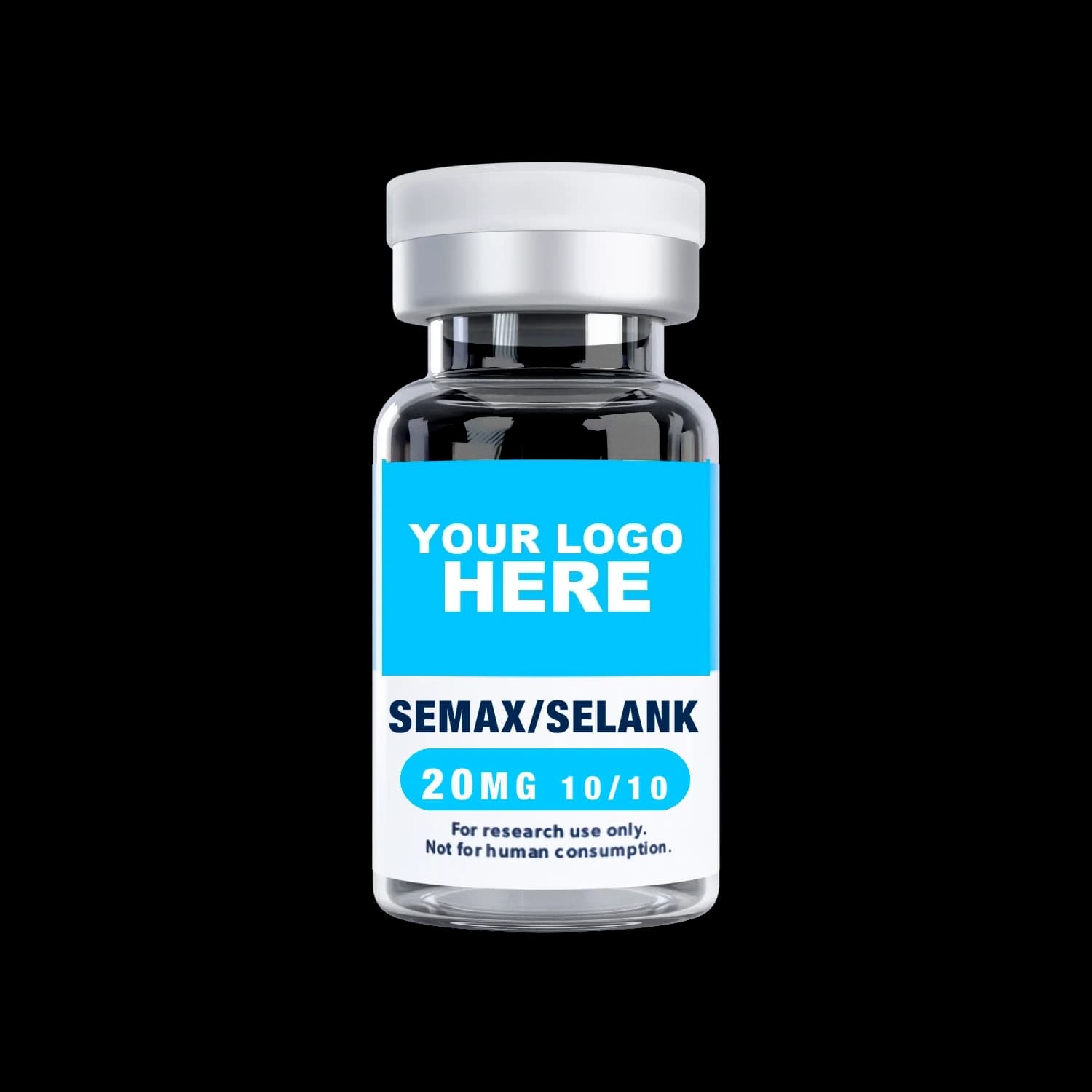
Semax / Selank Blend 20mg (10/10)50% off
WPSSMSK10 · CAS Multi-component · Custom Blends
$48.88$24.44/vial · 50% off at any volumeWhile supplies last
Discontinued — limited to stock on hand. Once it's gone, it's gone. Sold in kits of 10 vials · 100-vial order minimum (mix & match across compounds).
Overview
A research formulation pairing Semax, an ACTH(4-10) analog, with Selank, a tuftsin analog. Both are Russian-developed regulatory peptides and are frequently studied side by side in neuropeptide research.
History
Combines two peptides from the same Russian regulatory-peptide research program — one derived from ACTH(4-10), the other from the immunomodulatory tetrapeptide tuftsin — supplied together for comparative and combined-pathway work.
Two Russian regulatory peptides, two different parents
This blend pairs Semax and Selank, which are routinely mentioned in the same breath because both emerged from the same body of Soviet and Russian peptide research. They are not variations on one another.
Semax is an analogue of ACTH(4-10) — a fragment of adrenocorticotropic hormone with the hormonal activity engineered out and the neuroactive fragment retained. Its research sits in neurotrophic signalling: BDNF and NGF pathway activity and the cascades downstream of them.
Selank is an analogue of tuftsin, a tetrapeptide fragment of the immunoglobulin heavy chain. Its lineage is immune rather than endocrine, and the signalling studied around it reflects that.
So the blend combines two distinct parent molecules from two distinct systems, which is exactly why combined-versus-single-peptide comparative models exist for it: the question is whether the two pathways interact or simply run in parallel. Both components are also stocked individually for that reason.
Supplied lyophilised; stored at -20°C protected from light, reconstituted solution refrigerated at 2-8°C. General reagent handling guidance only.
Key Areas of Research
- Neurotrophic signaling: BDNF/NGF pathways
- Tuftsin-derived immune signaling
- Combined vs. single-peptide comparative models
References
- Ashmarin I.P. et al. (1997). Semax: a regulatory peptide. Neurosci Behav Physiol.
- Kozlovskaya M.M. et al. (2003). Selank and short peptides of the tuftsin family. Zh Vyssh Nerv Deiat.
- Dolotov O.V. et al. (2006). Semax and BDNF expression. Brain Res, 1117(1):54–60.
Semax / Selank Blend — Frequently Asked Questions
- What is Semax / Selank Blend?
- A research formulation pairing Semax, an ACTH(4-10) analog, with Selank, a tuftsin analog. Both are Russian-developed regulatory peptides and are frequently studied side by side in neuropeptide research.
- What doses of Semax / Selank Blend are available wholesale?
- Wholesale Peptide Supply stocks Semax / Selank Blend in 20mg (10/10). Wholesale pricing is provided by quote based on order volume across 100–1,000 vials.
- Is Semax / Selank Blend third-party tested?
- Yes. Every lot of Semax / Selank Blend is tested by an independent third-party laboratory using HPLC/MS, and a per-lot Certificate of Analysis documenting identity and purity is included with every order at no charge, issued in the name of Wholesale Peptide Supply.
- Is Semax / Selank Blend for human use?
- No. Semax / Selank Blend is sold strictly as a chemical reagent for in-vitro laboratory research and is not for human or veterinary use. Wholesale Peptide Supply is not a pharmacy or compounding facility.
- How do I get wholesale pricing for Semax / Selank Blend?
- Request a quote through our contact form or open a wholesale account. An account manager replies with volume pricing and lead times, typically within 10 minutes during business hours.
- Can I order Semax / Selank Blend in bulk?
- Yes. Semax / Selank Blend is available for bulk and wholesale orders, quoted by dose and volume, with the lower price earned per compound at 100 kits (1,000 vials). Submit the doses and quantities you need for a bulk quote.
Related Compounds
Custom Blends
GLOW Blend
The GLOW Blend combines GHK-Cu, BPC-157, and TB-500 in a single research formulation, studied across structural, epithelial, vascular, and systemic models.
View details →Custom Blends
KLOW Blend
The KLOW Blend extends the GLOW formulation with the addition of KPV, adding cytokine-modulating and immune signaling properties to the structural and vascular base blend.
View details →Custom Blends
Cagrilintide / Semaglutide Blend
A dual-agent research formulation pairing cagrilintide, a long-acting amylin analog, with semaglutide, a long-acting GLP-1 receptor agonist. Studied in laboratory models where amylin and incretin pathway signaling are examined together.
View details →Custom Blends
Retatrutide / Cagrilintide Blend
A dual-agent research formulation pairing retatrutide, a triple-pathway receptor agonist, with cagrilintide, a long-acting amylin analog. Studied where triple-agonist and amylin pathway signaling are examined together.
View details →GLP-1 & Metabolic
Semaglutide
Semaglutide is a synthetic peptide analog that functions as a long-acting pathway agonist, structurally modified for extended half-life and improved target binding affinity. It is studied in preclinical and laboratory models for its ability to activate target pathways and modulate downstream molecular signaling associated with endocrine regulation.
View details →GLP-1 & Metabolic
Tirzepatide
Tirzepatide is a synthetic peptide that functions as a dual pathway agonist, designed as a once-weekly investigational compound studied in preclinical laboratory models for receptor-mediated signaling and modulation of downstream cascades.
View details →GLP-1 & Metabolic
Retatrutide
Retatrutide is a synthetic investigational peptide developed as a multi-pathway agonist, representing the next generation of metabolic research compounds. It activates multiple target receptor subtypes for broad systemic effects studied in preclinical models.
View details →Growth Hormone
Ipamorelin
Ipamorelin is a synthetic pentapeptide and selective secretagogue-type agonist with minimal off-target pathway interference, used to study endocrine signaling and somatotroph axis modulation.
View details →