Research Use Only. Pinealon is sold as a chemical reagent for in-vitro laboratory research, not for human or veterinary use. It is not a drug, supplement, or compounded preparation. It must be handled by qualified professionals. Wholesale Peptide Supply is not a pharmacy or compounding facility under 503A or 503B.
Wholesale Pinealon — Bulk Research Supply
Available sizes
In-stock orders ship same day when paid by 1 pm PT, Mon–Fri. Overnight available.
Buy Pinealon wholesale and in bulk from a US-based research peptide supplier. Every lot is sourced in the USA and third-party tested, with the lab and method on each lot's certificate. Bulk Pinealon is quoted by dose and volume from a 3-kit (30-vial) order minimum, mix and match across doses and compounds; lower prices are earned at 10 kits and again at 100 kits in the order, mix and match.
Pinealon is the synthetic tripeptide Glu-Asp-Arg (EDR), one of the short peptide bioregulators developed in Russian gerontology research. It is studied in laboratory models of neuronal signaling and oxidative stress response.
Wholesale Catalog
Available Doses
Published per-vial wholesale pricing for Pinealon. Sold in kits of 10 vials with a 3-kit (30-vial) order minimum, mix and match across doses and compounds; lower prices apply at 10 kits and at 1,000+ vials in the order. Contact us for larger or custom-volume quotes — answered the same day. Urgent? Text or call (714) 625-9215 — you’ll reach a real person in the United States, not a chatbot or an overseas call center.
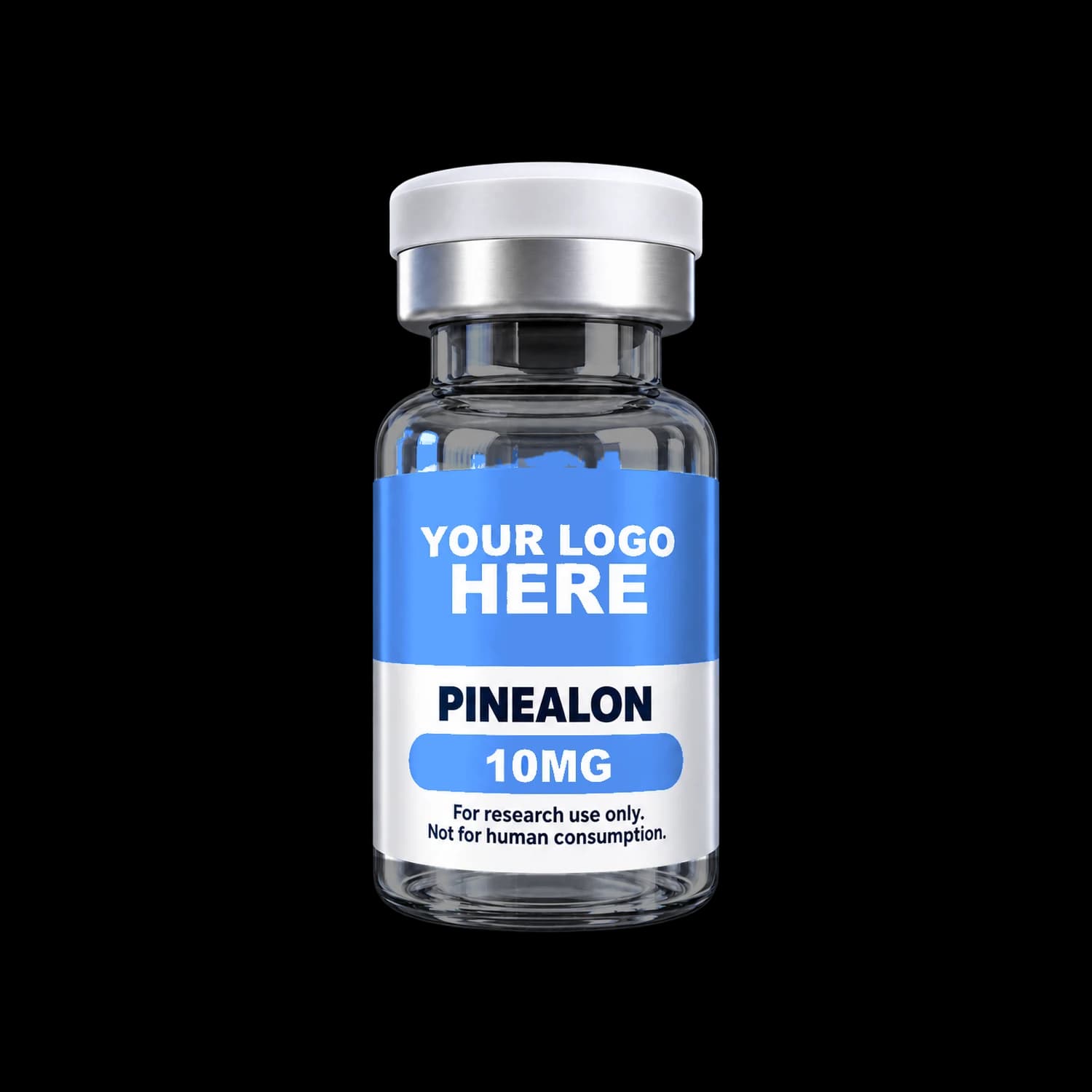
Pinealon 10mg
WPSPL10 · CAS 175175-23-2 · Neuropeptides
- 1–9 kits
- $14.38/vial card
$17.97wire/ACH/Zelle - 10–99 kits
- $11.50/vial card
$14.38wire/ACH/Zelle - 100+ kits
- $9.20/vial card
$11.50wire/ACH/Zelle
20% off with cardEarly Black Friday Sale: 20% off every order paid by card
Every product, every volume band — taken off your total at checkout when you choose card. Ends Wed, Nov 25
Sold in kits of 10 vials · 3-kit order minimum, mix and match · price set by the total kits in your order (BAC water not counted)
Questions? Text a rep or call (714) 625-9215 — a real person in the US answers.
Overview
Pinealon is the synthetic tripeptide Glu-Asp-Arg (EDR), one of the short peptide bioregulators developed in Russian gerontology research. It is studied in laboratory models of neuronal signaling and oxidative stress response.
History
Part of the Khavinson bioregulator series from the St. Petersburg Institute of Bioregulation and Gerontology, which characterized a family of short peptides reported to interact with DNA and modulate tissue-specific gene expression.
Pinealon among the Khavinson short peptides
Pinealon is the tripeptide Glu-Asp-Arg (EDR), one of three peptides from the Khavinson bioregulator series stocked here. The other two are Cartalax, reported as Ala-Glu-Asp (AED), and Epithalon, the tetrapeptide Ala-Glu-Asp-Gly (AEDG).
Cartalax and Epithalon share a backbone — the latter is the former plus a glycine. Pinealon does not: its sequence differs in composition rather than length, and it carries an arginine the other two lack. That makes it the useful outlier in comparative work across the series, since it separates sequence identity from the general question of whether very short peptides show activity at all.
Pinealon is studied in neuronal signalling and oxidative-stress models, and in short-peptide DNA-interaction research, which is the strand of the Khavinson literature concerned with whether tripeptides can act at the gene-regulatory level.
Handling
Three-residue peptides dissolve readily in bacteriostatic or sterile water and are not prone to the aggregation and surface-adsorption problems that affect larger molecules at dilute concentration.
The arginine residue makes the peptide basic, which is worth accounting for when selecting buffer conditions. As with the rest of the short bioregulator series, identity confirmation on the Certificate of Analysis carries more weight than usual: at this length, sequences are easily mis-specified and poorly distinguished by mass alone.
Lyophilised material is held at -20°C protected from light; reconstituted solution is refrigerated at 2-8°C. General laboratory handling of a chemical reagent only.
Pinealon (Glu-Asp-Arg) in the published record
The core Pinealon papers are short enough to list. Khavinson et al. (Rejuvenation Research, 2011, 14(5):535–541) reported that Pinealon restricted reactive oxygen species accumulation in a dose-dependent way in rat cerebellar granule cells, neutrophils and PC12 pheochromocytoma cells under oxidative stress, and reduced necrotic cell death measured by propidium iodide. The authors noted that the ROS effect saturated at lower concentrations while cell-cycle changes continued at higher ones, and argued from this that Pinealon acts on the genome as well as through antioxidant activity. ERK1/2 activation followed a delayed time course.
Arutjunyan et al. (International Journal of Clinical and Experimental Medicine, 2012) used a rat model of prenatal hyperhomocysteinemia induced by methionine loading during pregnancy. Offspring in the Pinealon group showed better spatial orientation and learning, and their isolated cerebellar neurons showed lower ROS accumulation and fewer necrotic cells. In 2021, Khavinson et al. (Pharmaceuticals 14(6):515) reported that EDR and the related tripeptide KED prevented dendritic spine loss in 5xFAD mice, and used docking models to predict EDR binding sites in promoter regions of genes including CASP3, GAP43, APOE, SOD2, PPARA and PPARG.
A 2020 review by the same group (Molecules 26(1):159) pulls these strands together around gene expression and protein synthesis. Chemically, Pinealon is the heaviest of the three bioregulators stocked here despite being a tripeptide: 418.40 g/mol against about 390 for Epithalon (AEDG) and 333.29 for Cartalax (AED), because arginine's guanidino side chain outweighs alanine and glycine together.
Pinealon and DNA: the binding studies, including one from outside the Khavinson group
The claim that sets Pinealon apart from conventional receptor ligands is that a three-residue peptide can reach the nucleus and interact with DNA. Two studies address that directly.
Fedoreyeva, Kireev, Khavinson and Vanyushin (Biochemistry (Moscow), 2011) incubated HeLa cells with fluorescein-labeled Pinealon, Epithalon and Testagen and observed fluorescence in the cytoplasm, nucleus and nucleolus. In fluorescence-quenching assays with labeled oligonucleotides, Pinealon bound preferentially to sequences containing CNG sites, CAG-containing sequences in particular.
Silanteva and colleagues at St. Petersburg State University (Journal of Physical Chemistry B, 2019), a group that does not include Khavinson, studied the EDR–DNA interaction by spectroscopy, NMR, viscometry and molecular dynamics. They reported that EDR partly enters the DNA major groove, contacting mainly the N7 and O6 atoms of guanine, and that Mg²⁺ ions promote the interaction by screening the phosphate backbone.
Outside that paper, nearly all Pinealon research comes from Khavinson's St. Petersburg Institute of Bioregulation and Gerontology and its collaborators, much of it in the Russian-language journal Advances in Gerontology. Independent replication is limited.
Certificates of Analysis
1 certificate is on file for Pinealon — open any one to read the full report.
| Lot / Lab | Dose | Tested | Purity | Certificate |
|---|---|---|---|---|
| 100089-0942Optiq Health LabsRP-HPLC / LC-MS | 10mg | 2026-08-20 | — |
Key Areas of Research
- Neuronal and neuroprotective research models
- Oxidative stress and apoptosis pathways
- Short-peptide DNA interaction studies
- Comparative studies across the bioregulator series
References
- Khavinson V.K. et al. (2011). Short peptides regulate gene expression. Bull Exp Biol Med, 152(1):125–128.
- Ashapkin V.V. et al. (2020). Epigenetic mechanisms of peptidergic regulation. Biochemistry (Moscow), 85(3):297–312.
Pinealon — Frequently Asked Questions
- What is Pinealon?
- Pinealon is the synthetic tripeptide Glu-Asp-Arg (EDR), one of the short peptide bioregulators developed in Russian gerontology research. It is studied in laboratory models of neuronal signaling and oxidative stress response.
- What is the CAS number for Pinealon?
- The CAS number for Pinealon is 175175-23-2. Its molecular formula is C₁₅H₂₆N₆O₈ (MW 418.41 g/mol).
- What doses of Pinealon are available wholesale?
- Wholesale Peptide Supply stocks Pinealon in 10mg. Wholesale pricing is provided by quote based on order volume, from a 3-kit (30-vial) order minimum, mix and match across doses and compounds.
- Is Pinealon third-party tested?
- Yes. Every lot of Pinealon is tested by an independent third-party laboratory, and a per-lot Certificate of Analysis is included with every order at no charge, issued in the name of Wholesale Peptide Supply. The most recent published lot, 100089-0942 (10mg), was tested by Optiq Health Labs on 20 August 2026 by RP-HPLC / LC-MS. Every lot on file is listed with its certificate on this page.
- Is Pinealon for human use?
- No. Pinealon is sold strictly as a chemical reagent for in-vitro laboratory research and is not for human or veterinary use. Wholesale Peptide Supply is not a pharmacy or compounding facility.
- How do I get wholesale pricing for Pinealon?
- Request a quote through our contact form or open a wholesale account. An account manager replies with volume pricing and lead times the same day. For anything urgent, text or call (714) 625-9215 to reach a real person in the US.
- Can I order Pinealon in bulk?
- Yes. Pinealon is available for bulk and wholesale orders, quoted by dose and volume, from a 3-kit (30-vial) order minimum, mix and match across doses and compounds, with lower prices at 10 kits and at 100 kits (1,000 vials) in the order. Submit the doses and quantities you need for a bulk quote.
- Is Pinalon the same as Pinealon?
- Yes. Pinalon is a common alternative spelling of Pinealon, the tripeptide H-Glu-Asp-Arg-OH (EDR). The certificate file for the lot on this page is labeled Pinalon; the compound is the same.
- Who developed Pinealon?
- Pinealon comes from the short-peptide bioregulator program of Vladimir Khavinson (1946–2024), who founded the St. Petersburg Institute of Bioregulation and Gerontology in 1992 and directed it. Epithalon and Cartalax come from the same program.
- Has Pinealon research been replicated outside the Khavinson group?
- Only to a limited extent. Most published Pinealon studies are by Khavinson's institute or its co-authors. One exception is a 2019 Journal of Physical Chemistry B study from St. Petersburg State University that examined the EDR–DNA interaction by NMR and molecular dynamics, reporting partial entry into the DNA major groove.
- Which Pinealon lot has a certificate on file?
- Lot 100089-0942 (10 mg), tested by Optiq Health Labs on August 20, 2026 using RP-HPLC / LC-MS. The certificate is listed on this page.
Related Compounds
Neuropeptides
Semax
Semax is a synthetic heptapeptide derived from ACTH 4-10 with a C-terminal Pro-Gly-Pro extension, studied for neuronal signaling, CNS pathway dynamics, and stress responses.
View details →Neuropeptides
Selank
Selank is a synthetic heptapeptide analog of tuftsin studied for neurotransmitter signaling, stress response, and immune signaling.
View details →Neuropeptides
DSIP
DSIP is a small amphiphilic nonapeptide with effects on circadian signaling and neuroendocrine regulation in experimental models.
View details →Neuropeptides
Dihexa
Dihexa is a small-molecule angiotensin IV analog studied in laboratory models of hepatocyte growth factor / c-Met signaling and synaptic pathway activity.
View details →GLP Series Peptides
GLP-1S
GLP-1S is a synthetic peptide analog that functions as a long-acting pathway agonist, structurally modified for extended half-life and improved target binding affinity. It is studied in preclinical and laboratory models for its ability to activate target pathways and modulate downstream molecular signaling associated with endocrine regulation.
View details →GLP Series Peptides
GLP-2T
GLP-2T is a synthetic peptide that functions as a dual pathway agonist, designed as a once-weekly investigational compound studied in preclinical laboratory models for receptor-mediated signaling and modulation of downstream cascades.
View details →GLP Series Peptides
GLP-3R
GLP-3R is a synthetic investigational peptide developed as a multi-pathway agonist, representing the next generation of metabolic research compounds. It activates multiple target receptor subtypes for broad systemic effects studied in preclinical models.
View details →Secretagogue Peptides
Ipamorelin
Ipamorelin is a synthetic pentapeptide and selective secretagogue-type agonist with minimal off-target pathway interference, used to study endocrine signaling and somatotroph axis modulation.
View details →