Research Use Only. Melanotan I is sold as a chemical reagent for in-vitro laboratory research. It is not a drug, supplement, or compounded preparation, and it is not for human or veterinary use. It must be handled by qualified professionals. Wholesale Peptide Supply is not a pharmacy or compounding facility under 503A or 503B.
Wholesale Melanotan I — Bulk Research Supply
Buy Melanotan I wholesale and in bulk from a US-based research peptide supplier. Every lot is sourced in the USA and third-party tested via HPLC/MS. Bulk Melanotan I is quoted by dose and volume from a 100-vial mix-and-match minimum; volume pricing is earned per compound at 100 kits.
Melanotan I (afamelanotide) is a 13-amino-acid analog of α-melanocyte stimulating hormone, [Nle⁴, D-Phe⁷]-α-MSH. It is studied as a melanocortin-1 receptor agonist in laboratory pigmentation and photoprotection models.
Wholesale Catalog
Available Doses
Published per-vial wholesale pricing for Melanotan I. Sold in kits of 10 vials with a 100-vial order minimum you can mix and match across compounds; volume pricing applies at 1,000+ vials. Contact us for larger or custom-volume quotes — typically answered within 10 minutes during business hours.
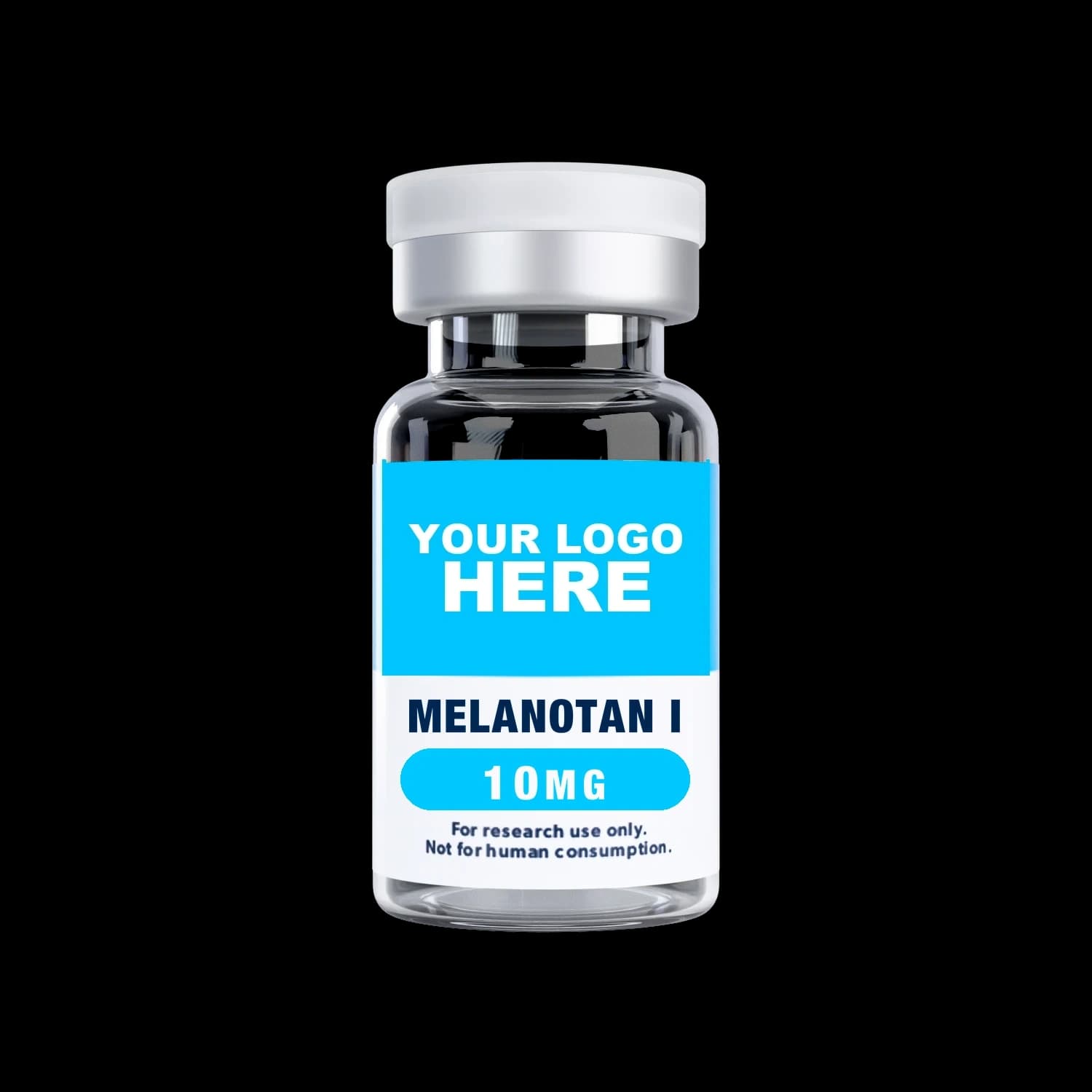
Melanotan I 10mg50% off
WPSMT110 · CAS 75921-69-6 · Melanocortin
$14.38$7.19/vial · 50% off at any volumeWhile supplies last
Discontinued — limited to stock on hand. Once it's gone, it's gone. Sold in kits of 10 vials · 100-vial order minimum (mix & match across compounds).
Overview
Melanotan I (afamelanotide) is a 13-amino-acid analog of α-melanocyte stimulating hormone, [Nle⁴, D-Phe⁷]-α-MSH. It is studied as a melanocortin-1 receptor agonist in laboratory pigmentation and photoprotection models.
History
Developed from α-MSH with norleucine and D-phenylalanine substitutions that resist enzymatic degradation and increase receptor affinity relative to the native hormone. It is the more MC1R-selective counterpart to Melanotan II.
Melanotan I and Melanotan II are not interchangeable
Both are α-MSH analogues and the names are one numeral apart, which is why they are among the most commonly mis-ordered pair in the melanocortin category.
Melanotan I (afamelanotide) is a linear 13-residue peptide, [Nle⁴, D-Phe⁷]-α-MSH — the native α-MSH sequence with two substitutions that resist enzymatic breakdown. It is substantially selective for MC1R. Melanotan II is a cyclic heptapeptide and is nonselective, engaging MC1R, MC3R, MC4R and MC5R alike.
Selectivity is the reason to choose this one. Pigmentation and photoprotection models that need MC1R signalling studied without concurrent MC3R, MC4R and MC5R activity use Melanotan I precisely because the broader agonist would introduce those pathways as confounds.
The two are complements in a receptor-selectivity comparison, not substitutes in a protocol.
Handling
At 13 residues and linear, Melanotan I is more susceptible to surface adsorption at dilute working concentrations than the cyclic analogue, so low-binding labware is the usual precaution when preparing dilute solutions.
The compound ships lyophilised and is reconstituted with bacteriostatic or sterile water added down the vial wall and swirled gently. Lyophilised material is held at -20°C protected from light; reconstituted solution is refrigerated at 2-8°C. General reagent handling guidance only, not human or veterinary use instruction.
Key Areas of Research
- MC1R binding and selectivity across melanocortin receptors
- Melanogenesis and eumelanin pathway models
- Photoprotection research
- Comparative studies vs. Melanotan II and native α-MSH
References
- Sawyer T.K. et al. (1980). 4-Norleucine, 7-D-phenylalanine-α-melanocyte-stimulating hormone. PNAS, 77(10):5754–5758.
- Langendonk J.G. et al. (2015). Afamelanotide for erythropoietic protoporphyria. N Engl J Med, 373(1):48–59.
Melanotan I — Frequently Asked Questions
- What is Melanotan I?
- Melanotan I (afamelanotide) is a 13-amino-acid analog of α-melanocyte stimulating hormone, [Nle⁴, D-Phe⁷]-α-MSH. It is studied as a melanocortin-1 receptor agonist in laboratory pigmentation and photoprotection models.
- What is the CAS number for Melanotan I?
- The CAS number for Melanotan I is 75921-69-6. Its molecular formula is C₇₈H₁₁₁N₂₁O₁₉ (MW 1,646.85 g/mol).
- What doses of Melanotan I are available wholesale?
- Wholesale Peptide Supply stocks Melanotan I in 10mg. Wholesale pricing is provided by quote based on order volume across 100–1,000 vials.
- Is Melanotan I third-party tested?
- Yes. Every lot of Melanotan I is tested by an independent third-party laboratory using HPLC/MS, and a per-lot Certificate of Analysis documenting identity and purity is included with every order at no charge, issued in the name of Wholesale Peptide Supply.
- Is Melanotan I for human use?
- No. Melanotan I is sold strictly as a chemical reagent for in-vitro laboratory research and is not for human or veterinary use. Wholesale Peptide Supply is not a pharmacy or compounding facility.
- How do I get wholesale pricing for Melanotan I?
- Request a quote through our contact form or open a wholesale account. An account manager replies with volume pricing and lead times, typically within 10 minutes during business hours.
- Can I order Melanotan I in bulk?
- Yes. Melanotan I is available for bulk and wholesale orders, quoted by dose and volume, with the lower price earned per compound at 100 kits (1,000 vials). Submit the doses and quantities you need for a bulk quote.
Related Compounds
Melanocortin
Melanotan II
Melanotan II is a synthetic cyclic heptapeptide analog of α-MSH acting as a nonselective melanocortin receptor agonist (MC1R, MC3R, MC4R, MC5R).
View details →Melanocortin
PT-141
PT-141 (Bremelanotide) is a synthetic α-MSH analog selective for central MC3R/MC4R activity, studied for neuroendocrine signaling and vascular pathways.
View details →Melanocortin
Oxytocin
Oxytocin is a cyclic nonapeptide synthesized in hypothalamic neurons. Through OXTR binding, it activates phospholipase C-mediated pathways. Studied for smooth muscle, CNS, and autonomic signaling.
View details →Melanocortin
Kisspeptin-10
Kisspeptin-10 is the decapeptide Tyr-Asn-Trp-Asn-Ser-Phe-Gly-Leu-Arg-Phe-NH₂, corresponding to the bioactive C-terminal residues 45-54 of metastin. It is studied as a KISS1R (GPR54) agonist in laboratory models of neuroendocrine signaling.
View details →Melanocortin
PT-141 Liquid Spray
PT-141 (Bremelanotide) supplied as an atomized solution in a metered spray bottle. A synthetic α-MSH analog selective for central MC3R/MC4R activity, supplied in solution rather than as a lyophilised solid.
View details →Melanocortin
MT-2 (Melanotan II) Liquid Spray
Melanotan II supplied as an atomized solution in a metered spray bottle — a cyclic α-MSH analog with broad melanocortin receptor activity.
View details →GLP-1 & Metabolic
Semaglutide
Semaglutide is a synthetic peptide analog that functions as a long-acting pathway agonist, structurally modified for extended half-life and improved target binding affinity. It is studied in preclinical and laboratory models for its ability to activate target pathways and modulate downstream molecular signaling associated with endocrine regulation.
View details →GLP-1 & Metabolic
Tirzepatide
Tirzepatide is a synthetic peptide that functions as a dual pathway agonist, designed as a once-weekly investigational compound studied in preclinical laboratory models for receptor-mediated signaling and modulation of downstream cascades.
View details →