Research Use Only. Kisspeptin-10 is sold as a chemical reagent for in-vitro laboratory research, not for human or veterinary use. It is not a drug, supplement, or compounded preparation. It must be handled by qualified professionals. Wholesale Peptide Supply is not a pharmacy or compounding facility under 503A or 503B.
Wholesale Kisspeptin-10 — Bulk Research Supply
Also written Kisspeptin 10 or KP-10.
Available sizes
In-stock orders ship same day when paid by 1 pm PT, Mon–Fri. Overnight available.
Buy Kisspeptin-10 wholesale and in bulk from a US-based research peptide supplier. Every lot is sourced in the USA and third-party tested, with the lab and method on each lot's certificate. Bulk Kisspeptin-10 is quoted by dose and volume from a 3-kit (30-vial) order minimum, mix and match across doses and compounds; lower prices are earned at 10 kits and again at 100 kits in the order, mix and match.
Kisspeptin-10 is the decapeptide Tyr-Asn-Trp-Asn-Ser-Phe-Gly-Leu-Arg-Phe-NH₂, corresponding to the bioactive C-terminal residues 45-54 of metastin. It is studied as a KISS1R (GPR54) agonist in laboratory models of neuroendocrine signaling.
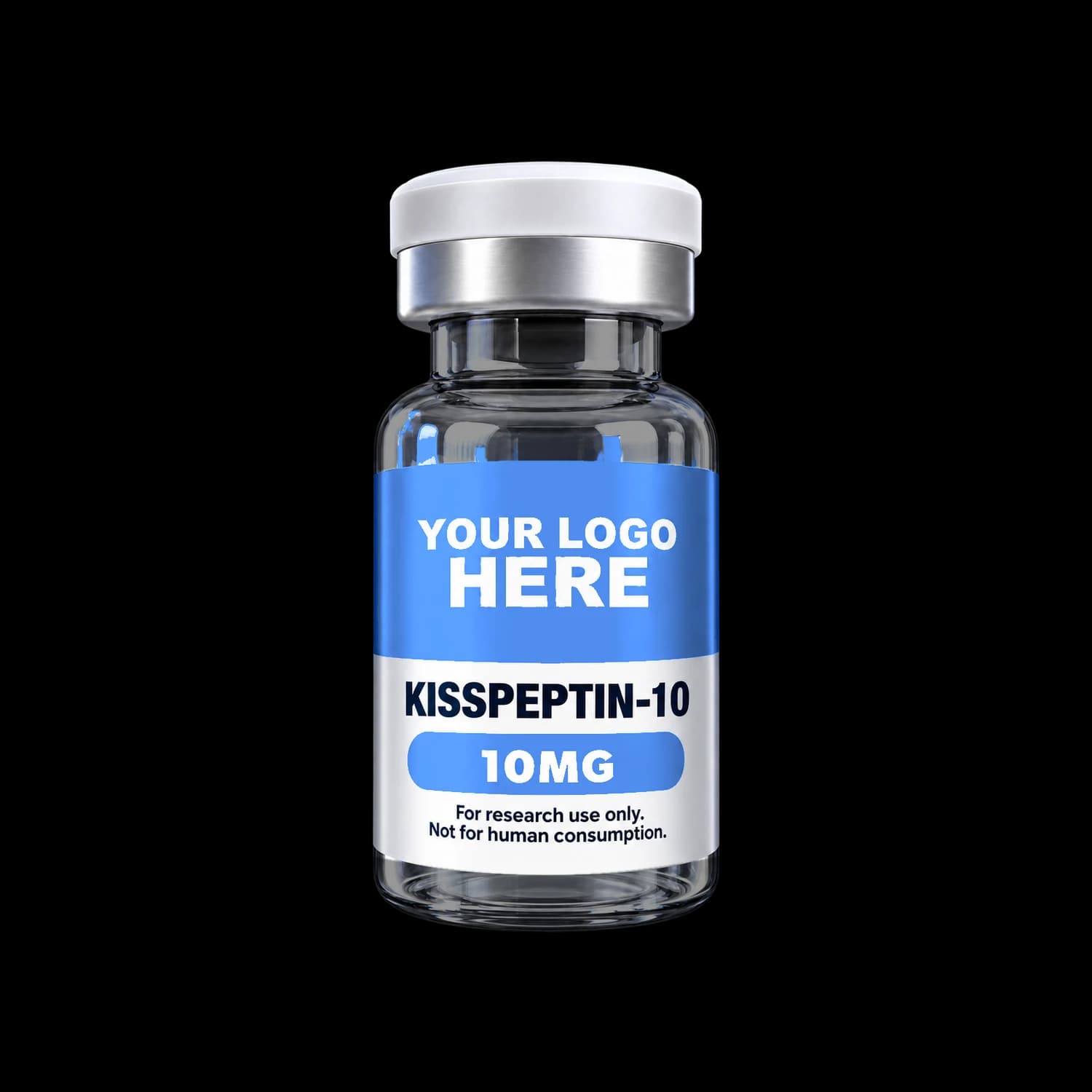
Wholesale Catalog
Available Doses
Published per-vial wholesale pricing for Kisspeptin-10. Sold in kits of 10 vials with a 3-kit (30-vial) order minimum, mix and match across doses and compounds; lower prices apply at 10 kits and at 1,000+ vials in the order. Contact us for larger or custom-volume quotes — answered the same day. Urgent? Text or call (714) 625-9215 — you’ll reach a real person in the United States, not a chatbot or an overseas call center.
Kisspeptin-10 10mg
WPSKIS10 · CAS 374675-21-5 · Melanocortin Peptides
- 1–9 kits
- $15.24/vial card
$19.05wire/ACH/Zelle - 10–99 kits
- $12.19/vial card
$15.24wire/ACH/Zelle - 100+ kits
- $9.75/vial card
$12.19wire/ACH/Zelle
20% off with cardEarly Black Friday Sale: 20% off every order paid by card
Every product, every volume band — taken off your total at checkout when you choose card. Ends Wed, Nov 25
Sold in kits of 10 vials · 3-kit order minimum, mix and match · price set by the total kits in your order (BAC water not counted)
Questions? Text a rep or call (714) 625-9215 — a real person in the US answers.
Overview
Kisspeptin-10 is the decapeptide Tyr-Asn-Trp-Asn-Ser-Phe-Gly-Leu-Arg-Phe-NH₂, corresponding to the bioactive C-terminal residues 45-54 of metastin. It is studied as a KISS1R (GPR54) agonist in laboratory models of neuroendocrine signaling.
History
The KISS1 gene was first characterized as a metastasis suppressor, and its peptide products were later identified as the endogenous ligands of GPR54, establishing the kisspeptin system as an upstream regulator in reproductive neuroendocrinology.
Where Kisspeptin-10 sits in the neuroendocrine cascade
Kisspeptin-10 is the decapeptide Tyr-Asn-Trp-Asn-Ser-Phe-Gly-Leu-Arg-Phe-NH₂, corresponding to residues 45-54 of metastin — the bioactive C-terminal fragment of the full KISS1 gene product.
Its research value comes largely from where it acts in the sequence of events rather than from the receptor alone. Signalling through KISS1R (GPR54) sits upstream of GnRH release, which in turn sits upstream of the gonadotropins. That puts Kisspeptin-10 at a different level of the same axis that HCG and HMG are used to probe further down.
So a model choosing between them is choosing where to intervene: Kisspeptin-10 for the neuroendocrine step that drives the cascade, the gonadotropin reagents for the receptor-level events it eventually produces. They are not alternatives and the readouts are not equivalent.
The KISS1 gene was first characterised as a metastasis suppressor, which is why the same peptide also appears in oncology-adjacent signalling work unrelated to reproductive endocrinology.
Handling
At ten residues the peptide is robust relative to the larger compounds in this catalogue, but the C-terminal amide and the tryptophan residue both make it worth protecting from light and from prolonged room-temperature holding.
It ships lyophilised and reconstitutes readily in bacteriostatic or sterile water at a volume chosen to reach the assay's target concentration. Low-binding labware is the usual choice for dilute working solutions. Lyophilised material is stored at -20°C protected from light; reconstituted solution is refrigerated at 2-8°C.
General laboratory handling of a chemical reagent only.
Kisspeptin-10's name: from a Hershey melanoma lab to Takeda's metastin
The gene behind Kisspeptin-10 was found in Hershey, Pennsylvania. In 1996 Lee, Miele, Hicks and colleagues in Danny Welch's group at the Penn State College of Medicine in Hershey reported KiSS-1 in the Journal of the National Cancer Institute. It was a cDNA expressed only in non-metastatic melanoma cells. The team isolated it from C8161 and MelJuSo melanoma lines in which microcell transfer of human chromosome 6 had suppressed metastasis by at least 95%. The name combines the lab's 'SS' convention for suppressor sequences with a nod to the town's best-known product, Hershey's Kisses.
The receptor arrived separately. In 1999 Lee and colleagues (FEBS Letters) cloned GPR54 from rat brain: a 396-residue orphan receptor sharing about 45% transmembrane identity with the galanin receptors, yet with no specific galanin binding. In 2001 two groups joined ligand and receptor. At Takeda's Tsukuba laboratories, Ohtaki et al. (Nature) isolated from human placenta a 54-residue, C-terminally amidated KiSS-1 product that activates the orphan receptor hOT7T175, and named it metastin. Kotani et al. (Journal of Biological Chemistry) reported the kisspeptin family as GPR54's natural ligands in the same year.
Kisspeptin-10 is the last ten residues of that 54-mer, and all the longer kisspeptins share it. In 2003 two groups reported GPR54 loss of function associated with hypogonadotropic hypogonadism: Seminara et al. (New England Journal of Medicine), working from a consanguineous family and a Gpr54-deficient mouse, and de Roux et al. (PNAS). Those papers moved the system from oncology into neuroendocrinology.
Kisspeptin-10 vs kisspeptin-54: about four minutes against half an hour
The main experimental difference between Kisspeptin-10 and the full-length peptide is clearance. Jayasena et al. (Journal of Clinical Endocrinology & Metabolism, 2011) measured the plasma half-life of kisspeptin-10 immunoreactivity at 3.8 ± 0.3 minutes in men and 4.1 ± 0.4 minutes in women, about seven-fold shorter than kisspeptin-54. A 2017 mouse study by d'Anglemont de Tassigny, Jayasena, Murphy, Dhillo and Colledge (PLoS ONE) put the figures at roughly 4 minutes for KP-10 and 32 minutes for KP-54.
Clearance did not explain everything, though. In that study, repeated KP-10 injections every 10 minutes did not reproduce the sustained LH rise seen after one KP-54 dose, and only KP-54 reached and activated GnRH neurons behind the blood-brain barrier after peripheral dosing in mice.
The decapeptide has also been the starting point for analogs with more durable activity. Curtis et al. (American Journal of Physiology – Endocrinology and Metabolism, 2010) described a kisspeptin-10 analog with greater in vivo bioactivity. Takeda's investigational nonapeptides, including TAK-448 (Nishizawa et al., Journal of Medicinal Chemistry, 2016), are built on metastin residues 46 to 54, the last nine residues of Kisspeptin-10, with substitutions at several positions. The TAK-448 paper's title reports highly potent testosterone-suppressive activity and excellent water solubility.
Certificates of Analysis
4 certificates are on file for Kisspeptin-10 — open any one to read the full report.
Latest full-panel results: lot WPS-KIS10-20261005-01 (10mg)
pH Solutions Lab, reported 16 October 2026
- Purity (HPLC-UV)
- 99%
- Net peptide content
- 10.99 mg/vial
- Water activity
- 0.29 aw (limit < 0.65)
- Microbials
- 7 organisms screened, all pass
- Heavy metals (on the API lot)
- Lead tested, all pass
- Residual solvents (on the API lot)
- 5 solvents screened, all pass
| Lot / Lab | Dose | Tested | Purity | Certificate |
|---|---|---|---|---|
| WPS-KIS10-20261005-01pH Solutions LabHPLC-UV | 10mg | 2026-10-16 | 99%Also: net content 10.99 mg/vial · water activity 0.29 aw · microbials · heavy metals · residual solvents | Verify at lab ↗ |
| WPS-KIS10-20260918-01pH Solutions LabHPLC-UV | 10mg | 2026-10-08 | 99%Also: net content 9.10 mg/vial · water activity 0.30 aw · microbials · heavy metals · residual solvents | Verify at lab ↗ |
| 100089-0935Optiq Health LabsRP-HPLC / LC-MS | 10mg | 2026-08-20 | — | |
| 100032-0313Optiq Health LabsRP-HPLC / LC-MS | 10mg | 2026-07-29 | — |
Key Areas of Research
- KISS1R / GPR54 receptor binding
- Neuroendocrine signaling cascades
- Metastasis-suppressor pathway research
- Structure-activity work across kisspeptin fragments
References
- Kotani M. et al. (2001). The metastasis suppressor gene KiSS-1 encodes kisspeptins, the natural ligands of the orphan G protein-coupled receptor GPR54. J Biol Chem, 276(37):34631–34636.
- de Roux N. et al. (2003). Hypogonadotropic hypogonadism due to loss of function of the KiSS1-derived peptide receptor GPR54. PNAS, 100(19):10972–10976.
Kisspeptin-10 — Frequently Asked Questions
- What is Kisspeptin-10?
- Kisspeptin-10 is the decapeptide Tyr-Asn-Trp-Asn-Ser-Phe-Gly-Leu-Arg-Phe-NH₂, corresponding to the bioactive C-terminal residues 45-54 of metastin. It is studied as a KISS1R (GPR54) agonist in laboratory models of neuroendocrine signaling.
- What is the CAS number for Kisspeptin-10?
- The CAS number for Kisspeptin-10 is 374675-21-5. Its molecular formula is C₆₃H₈₃N₁₇O₁₄ (MW 1,302.45 g/mol).
- What doses of Kisspeptin-10 are available wholesale?
- Wholesale Peptide Supply stocks Kisspeptin-10 in 10mg. Wholesale pricing is provided by quote based on order volume, from a 3-kit (30-vial) order minimum, mix and match across doses and compounds.
- Is Kisspeptin-10 third-party tested?
- Yes. Every lot of Kisspeptin-10 is tested by an independent third-party laboratory, and a per-lot Certificate of Analysis documenting identity and purity is included with every order at no charge, issued in the name of Wholesale Peptide Supply. The most recent published lot, WPS-KIS10-20261005-01 (10mg), was tested by pH Solutions Lab on 16 October 2026 by HPLC-UV: purity 99%. Every lot on file is listed with its certificate on this page.
- Is Kisspeptin-10 tested for heavy metals, residual solvents and microbial contamination?
- Yes, on the lots tested by pH Solutions Lab. The most recent, lot WPS-KIS10-20261005-01 (10mg), reported 16 October 2026, shows purity 99% by HPLC-UV; net peptide content: 10.99 mg/vial; water activity: 0.29 aw (limit < 0.65); microbials: 7 organisms screened, all pass; heavy metals (on the API lot): lead tested, all pass; residual solvents (on the API lot): 5 solvents screened, all pass. The lab publishes its own online record of the certificate, linked beside the lot on this page, so every figure can be checked at the source.
- Is Kisspeptin-10 for human use?
- No. Kisspeptin-10 is sold strictly as a chemical reagent for in-vitro laboratory research and is not for human or veterinary use. Wholesale Peptide Supply is not a pharmacy or compounding facility.
- How do I get wholesale pricing for Kisspeptin-10?
- Request a quote through our contact form or open a wholesale account. An account manager replies with volume pricing and lead times the same day. For anything urgent, text or call (714) 625-9215 to reach a real person in the US.
- Can I order Kisspeptin-10 in bulk?
- Yes. Kisspeptin-10 is available for bulk and wholesale orders, quoted by dose and volume, from a 3-kit (30-vial) order minimum, mix and match across doses and compounds, with lower prices at 10 kits and at 100 kits (1,000 vials) in the order. Submit the doses and quantities you need for a bulk quote.
- Is human Kisspeptin-10 the same sequence as mouse or rat kisspeptin-10?
- No. They differ at the C-terminal residue. Human Kisspeptin-10 is Tyr-Asn-Trp-Asn-Ser-Phe-Gly-Leu-Arg-Phe-NH₂, while the mouse and rat KISS1 precursors (UniProt Q6Y4S4 and Q7TSB7) encode YNWNSFGLRY, ending in Tyr before the amidation signal. The product supplied here is the human sequence, which matters when a rodent study needs to specify which peptide was used.
- Why is it called kisspeptin?
- The KiSS-1 gene was discovered in 1996 at Penn State's campus in Hershey, Pennsylvania (Lee et al., J Natl Cancer Inst). Its name pairs the lab's 'SS' label for suppressor sequences with a reference to Hershey's Kisses. Takeda's group named the 54-residue product metastin in 2001, after showing it inhibited chemotaxis and invasion of receptor-expressing cells; kisspeptin-54 and metastin refer to the same peptide.
- What is the half-life of Kisspeptin-10?
- Short. Jayasena et al. (J Clin Endocrinol Metab, 2011) measured plasma kisspeptin-10 immunoreactivity falling with a half-life of 3.8 ± 0.3 minutes in men and 4.1 ± 0.4 minutes in women, about seven-fold shorter than kisspeptin-54. A 2017 mouse study gave roughly 4 minutes for KP-10 against about 32 minutes for KP-54.
- Which Kisspeptin-10 certificates are on file?
- Two 10 mg lots, both tested by Optiq Health Labs with RP-HPLC / LC-MS recorded as the method. Lot 100032-0313 was tested on July 29, 2026, and lot 100089-0935 on August 20, 2026. Both certificates are linked on this page.
Related Compounds
Melanocortin Peptides
Melanotan II
Melanotan II is a synthetic cyclic heptapeptide analog of α-MSH acting as a nonselective melanocortin receptor agonist (MC1R, MC3R, MC4R, MC5R).
View details →Melanocortin Peptides
PT-141
PT-141 (Bremelanotide) is a synthetic α-MSH analog selective for central MC3R/MC4R activity, studied for neuroendocrine signaling and vascular pathways.
View details →Melanocortin Peptides
Oxytocin
Oxytocin is a cyclic nonapeptide synthesized in hypothalamic neurons. Through OXTR binding, it activates phospholipase C-mediated pathways. Studied for smooth muscle, CNS, and autonomic signaling.
View details →Melanocortin Peptides
Melanotan I
Melanotan I (afamelanotide) is a 13-amino-acid analog of α-melanocyte stimulating hormone, [Nle⁴, D-Phe⁷]-α-MSH. It is studied as a melanocortin-1 receptor agonist in laboratory pigmentation and photoprotection models.
View details →GLP Series Peptides
GLP-1S
GLP-1S is a synthetic peptide analog that functions as a long-acting pathway agonist, structurally modified for extended half-life and improved target binding affinity. It is studied in preclinical and laboratory models for its ability to activate target pathways and modulate downstream molecular signaling associated with endocrine regulation.
View details →GLP Series Peptides
GLP-2T
GLP-2T is a synthetic peptide that functions as a dual pathway agonist, designed as a once-weekly investigational compound studied in preclinical laboratory models for receptor-mediated signaling and modulation of downstream cascades.
View details →GLP Series Peptides
GLP-3R
GLP-3R is a synthetic investigational peptide developed as a multi-pathway agonist, representing the next generation of metabolic research compounds. It activates multiple target receptor subtypes for broad systemic effects studied in preclinical models.
View details →Secretagogue Peptides
Ipamorelin
Ipamorelin is a synthetic pentapeptide and selective secretagogue-type agonist with minimal off-target pathway interference, used to study endocrine signaling and somatotroph axis modulation.
View details →