Research Use Only. GHRP-6 Acetate is sold as a chemical reagent for in-vitro laboratory research, not for human or veterinary use. It is not a drug, supplement, or compounded preparation. It must be handled by qualified professionals. Wholesale Peptide Supply is not a pharmacy or compounding facility under 503A or 503B.
Wholesale GHRP-6 Acetate — Bulk Research Supply
Also written GHRP 6 or GHRP6.
Buy GHRP-6 Acetate wholesale and in bulk from a US-based research peptide supplier. Every lot is sourced in the USA and third-party tested, with the lab and method on each lot's certificate. Bulk GHRP-6 Acetate is quoted by dose and volume from a 3-kit (30-vial) order minimum, mix and match across doses and compounds; lower prices are earned at 10 kits and again at 100 kits in the order, mix and match.
GHRP-6 is a synthetic hexapeptide growth hormone secretagogue with the sequence His-D-Trp-Ala-Trp-D-Phe-Lys-NH₂. It was the first of the GHRP series to be widely characterized and remains a common reference compound in secretagogue research.
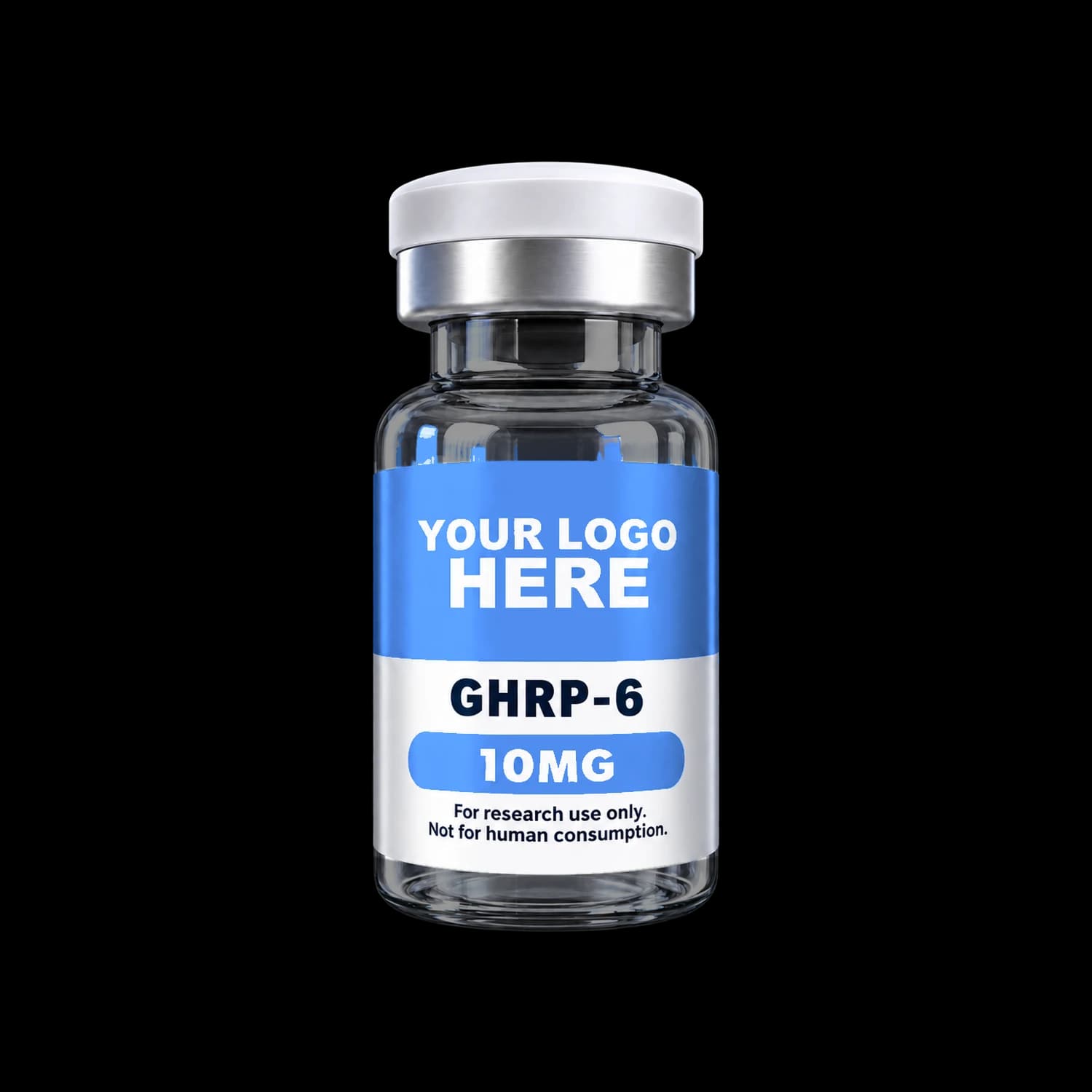
Wholesale Catalog
Available Doses
Published per-vial wholesale pricing for GHRP-6 Acetate. Sold in kits of 10 vials with a 3-kit (30-vial) order minimum, mix and match across doses and compounds; lower prices apply at 10 kits and at 1,000+ vials in the order. Contact us for larger or custom-volume quotes — answered the same day. Urgent? Text or call (714) 625-9215 — you’ll reach a real person in the United States, not a chatbot or an overseas call center.
GHRP-6 Acetate 10mg
WPSGP610 · CAS 87616-84-0 · Secretagogue Peptides
Discontinued
This product is no longer stocked and is not being restocked.
Questions? Text a rep or call (714) 625-9215 — a real person in the US answers.
Overview
GHRP-6 is a synthetic hexapeptide growth hormone secretagogue with the sequence His-D-Trp-Ala-Trp-D-Phe-Lys-NH₂. It was the first of the GHRP series to be widely characterized and remains a common reference compound in secretagogue research.
History
Derived from the enkephalin-based secretagogue work of Bowers and colleagues, GHRP-6 established the peptide class that later produced GHRP-2, hexarelin and ipamorelin.
GHRP-6 and GHRP-2: choosing between them
Both are synthetic hexapeptide growth-hormone secretagogues acting at the ghrelin receptor. They are close enough in class to be shortlisted together and different enough that swapping one for the other changes what a study measures.
GHRP-6 carries His-D-Trp-Ala-Trp-D-Phe-Lys-NH₂ and was the first of the GHRP series to be widely characterised, which is why it persists as a reference compound. In preclinical models it produces a pronounced food-intake response alongside growth-hormone release, and that appetite signalling is generally the reason it is selected.
GHRP-2 (pralmorelin) carries D-Ala-D-2Nal-Ala-Trp-D-Phe-Lys-NH₂ and is the more potent of the two for GH release at equivalent concentration, with a less prominent appetite response.
Put simply: GHRP-6 is the usual choice when ghrelin-receptor appetite signalling is part of what is being studied, GHRP-2 when growth-hormone output is the endpoint on its own.
GHRP-6 began as a computer-designed enkephalin analog
GHRP-6 was not isolated from tissue; it was designed. Its starting point was the observation by Cyril Bowers' group at Tulane that two methionine-enkephalin analogs, [D-Trp2]- and [D-Phe2]-Met-enkephalin amide, weakly released GH from rat pituitary in vitro. Working with Frank Momany, the group ran conformational energy calculations on active and inactive analogs, predicted new sequences, synthesized them and repeated the cycle. Their 1981 Endocrinology paper reported the pentapeptide Tyr-D-Trp-Ala-Trp-D-Phe-NH₂ as roughly 1,000 times more active than the enkephalin starting points.
The hexapeptide followed in Bowers, Momany, Reynolds and Hong (Endocrinology, 1984), which named it [His1,Lys6]GHRP: His-D-Trp-Ala-Trp-D-Phe-Lys-NH₂. In that paper it was active in the pituitary incubation assay at 1 to 10 ng/mL, worked in rats, monkeys, lambs and calves, and in rats raised GH within 2 minutes of intravenous injection, peaking at 10 to 20 minutes and usually back to baseline by 2 hours. The authors also reported no concurrent release of LH, FSH, TSH or prolactin in their assays, and noted that somatostatin-28 inhibited the response about four times more strongly than somatostatin-14 in vitro.
GHRP-6 and the receptor found backwards: GHS-R1a, then ghrelin
GHRP-6 is a textbook case of reverse pharmacology. A synthetic ligand existed for twelve years before its receptor was cloned, and for fifteen before the body's own ligand was found. The receptor, now called GHS-R1a, was cloned by Howard and colleagues at Merck Research Laboratories in Rahway, New Jersey (Science, 1996). It is a G-protein-coupled receptor of the pituitary and the arcuate and infundibular hypothalamus of swine and humans, and the authors wrote that its characterization supported the notion that the secretagogues mimic an undiscovered hormone. The endogenous ligand came in December 1999, when Kojima, Kangawa and colleagues at Japan's National Cardiovascular Center Research Institute purified a 28-residue peptide from rat stomach whose serine 3 is n-octanoylated, an acylation the authors showed is essential for activity. They named it ghrelin, from the Proto-Indo-European root ghre, to grow.
That history is why GHRP-6 remains the reference ligand in GHS-R1a work: much of the receptor's early pharmacology was mapped with it before ghrelin was known. It also means GHRP-6 and ghrelin are structurally unrelated agonists of one receptor. GHRP-6 is a six-residue peptide with two D-amino acids and no acyl group, while ghrelin needs its octanoyl side chain to bind.
GHRP-6 carries two tryptophans; GHRP-2 carries one
GHRP-6 contains two tryptophan residues: D-Trp at position 2 and L-Trp at position 4. In GHRP-2 the position-2 D-Trp is replaced by D-2-naphthylalanine, so GHRP-2 keeps only Trp4. For GHRP-6, that makes tryptophan oxidation the main chemical liability to watch. The usual products are kynurenine (+4 Da), hydroxytryptophan or oxindolylalanine (+16 Da) and N-formylkynurenine (+32 Da), and with two indoles per molecule they can appear singly or doubly. The N-terminal His1, absent from GHRP-2, adds a second oxidation-prone side chain.
In practice that is why GHRP-6 is kept protected from light and from oxidizing conditions once in solution, and why a small late-eluting or mass-shifted shoulder in a GHRP-6 chromatogram is worth assigning rather than ignoring.
Certificates of Analysis
1 certificate is on file for GHRP-6 Acetate — open any one to read the full report.
| Lot / Lab | Dose | Tested | Purity | Certificate |
|---|---|---|---|---|
| 100057-0606Optiq Health LabsRP-HPLC | — | 2026-08-05 | — |
Key Areas of Research
- GHS-R1a receptor binding
- Ghrelin pathway comparisons
- Secretagogue class structure-activity relationships
- Appetite-signaling research models
References
- Bowers C.Y. et al. (1984). On the in vitro and in vivo activity of a new synthetic hexapeptide that acts on the pituitary to specifically release growth hormone. Endocrinology, 114(5):1537–1545.
- Howard A.D. et al. (1996). A receptor in pituitary and hypothalamus that functions in growth hormone release. Science, 273(5277):974–977.
GHRP-6 Acetate — Frequently Asked Questions
- What is GHRP-6 Acetate?
- GHRP-6 is a synthetic hexapeptide growth hormone secretagogue with the sequence His-D-Trp-Ala-Trp-D-Phe-Lys-NH₂. It was the first of the GHRP series to be widely characterized and remains a common reference compound in secretagogue research.
- What is the CAS number for GHRP-6 Acetate?
- The CAS number for GHRP-6 Acetate is 87616-84-0. Its molecular formula is C₄₆H₅₆N₁₂O₆ (MW 873.01 g/mol).
- What doses of GHRP-6 Acetate are available wholesale?
- Wholesale Peptide Supply stocks GHRP-6 Acetate in 10mg. Wholesale pricing is provided by quote based on order volume, from a 3-kit (30-vial) order minimum, mix and match across doses and compounds.
- Is GHRP-6 Acetate third-party tested?
- Yes. Every lot of GHRP-6 Acetate is tested by an independent third-party laboratory, and a per-lot Certificate of Analysis is included with every order at no charge, issued in the name of Wholesale Peptide Supply. The most recent published lot, 100057-0606, was tested by Optiq Health Labs on 5 August 2026 by RP-HPLC. Every lot on file is listed with its certificate on this page.
- Is GHRP-6 Acetate for human use?
- No. GHRP-6 Acetate is sold strictly as a chemical reagent for in-vitro laboratory research and is not for human or veterinary use. Wholesale Peptide Supply is not a pharmacy or compounding facility.
- How do I get wholesale pricing for GHRP-6 Acetate?
- Request a quote through our contact form or open a wholesale account. An account manager replies with volume pricing and lead times the same day. For anything urgent, text or call (714) 625-9215 to reach a real person in the US.
- Can I order GHRP-6 Acetate in bulk?
- Yes. GHRP-6 Acetate is available for bulk and wholesale orders, quoted by dose and volume, from a 3-kit (30-vial) order minimum, mix and match across doses and compounds, with lower prices at 10 kits and at 100 kits (1,000 vials) in the order. Submit the doses and quantities you need for a bulk quote.
- Why do older papers call GHRP-6 [His1,Lys6]GHRP?
- That was the name Bowers and colleagues used when they first reported the hexapeptide in Endocrinology in 1984. It marks the His added at position 1 and the Lys at position 6, built around the earlier pentapeptide Tyr-D-Trp-Ala-Trp-D-Phe-NH₂ from the same group. The short name GHRP-6 came into general use later.
- How does GHRP-6 compare with ipamorelin in published data?
- In Novo Nordisk's 1998 ipamorelin paper (Raun et al., Eur J Endocrinol), GHRP-6 released GH from primary rat pituitary cells with an EC50 of 2.2 nmol/L, against 1.3 nmol/L for ipamorelin. In conscious swine the ED50 values were 3.9 and 2.3 nmol/kg respectively. GHRP-6 raised plasma ACTH and cortisol in that model, while ipamorelin did not. Ipamorelin came out of a series designed without the central Ala-Trp dipeptide of the GHRP family.
- What certificate is on file for GHRP-6?
- The certificate currently listed for GHRP-6 is lot 100057-0606, tested by Optiq Health Labs on August 5, 2026, with RP-HPLC recorded as the method. It is linked on this page with the other certificates on file.
Related Compounds
Secretagogue Peptides
Tesamorelin
Tesamorelin is a synthetic analog of growth hormone releasing hormone built on the full 44-residue GHRH sequence, carrying an N-terminal trans-3-hexenoyl modification that resists enzymatic cleavage and extends the window of GHRH receptor engagement relative to native GHRH.
View details →Secretagogue Peptides
Ipamorelin
Ipamorelin is a synthetic pentapeptide and selective secretagogue-type agonist with minimal off-target pathway interference, used to study endocrine signaling and somatotroph axis modulation.
View details →Secretagogue Peptides
CJC-1295 w/DAC
CJC-1295 with DAC is a modified GHRH analog with prolonged half-life through albumin binding, enabling sustained somatotroph axis activation in experimental models.
View details →Secretagogue Peptides
CJC/IPA No DAC Blend
Combines CJC-1295 No DAC with Ipamorelin to target two complementary signaling pathways. The No DAC variant maintains a shorter duration of action enabling pulsatile GH dynamics.
View details →Secretagogue Peptides
IGF-LR3
IGF-LR3 (Long Arg3 IGF-1) is a synthetic IGF-1 analog with reduced IGFBP binding and significantly extended half-life, used to investigate IGF-1 receptor-mediated signaling and metabolic regulation.
View details →Secretagogue Peptides
CJC-1295 (no DAC)
CJC-1295 without DAC — also called modified GRF (1-29) — is a GHRH analog carrying four amino acid substitutions that resist enzymatic cleavage, without the drug affinity complex that extends the DAC variant's half-life.
View details →Secretagogue Peptides
GHRP-2 Acetate
GHRP-2 (pralmorelin) is a synthetic hexapeptide growth hormone secretagogue with the sequence D-Ala-D-2Nal-Ala-Trp-D-Phe-Lys-NH₂, studied as a ghrelin receptor agonist in laboratory models.
View details →Secretagogue Peptides
HCG
Human chorionic gonadotropin is a glycoprotein hormone made of a 92-amino-acid α-chain shared with LH, FSH and TSH, and a distinct 145-residue β-chain. It is supplied as a laboratory reagent and quantified in international units rather than by mass.
View details →