Research Use Only. Melanotan II is sold as a chemical reagent for in-vitro laboratory research, not for human or veterinary use. It is not a drug, supplement, or compounded preparation. It must be handled by qualified professionals. Wholesale Peptide Supply is not a pharmacy or compounding facility under 503A or 503B.
Wholesale Melanotan II — Bulk Research Supply
Available sizes
In-stock orders ship same day when paid by 1 pm PT, Mon–Fri. Overnight available.
Buy Melanotan II wholesale and in bulk from a US-based research peptide supplier. Every lot is sourced in the USA and third-party tested, with the lab and method on each lot's certificate. Bulk Melanotan II is quoted by dose and volume from a 3-kit (30-vial) order minimum, mix and match across doses and compounds; lower prices are earned at 10 kits and again at 100 kits in the order, mix and match.
Melanotan II is a synthetic cyclic heptapeptide analog of α-MSH acting as a nonselective melanocortin receptor agonist (MC1R, MC3R, MC4R, MC5R).
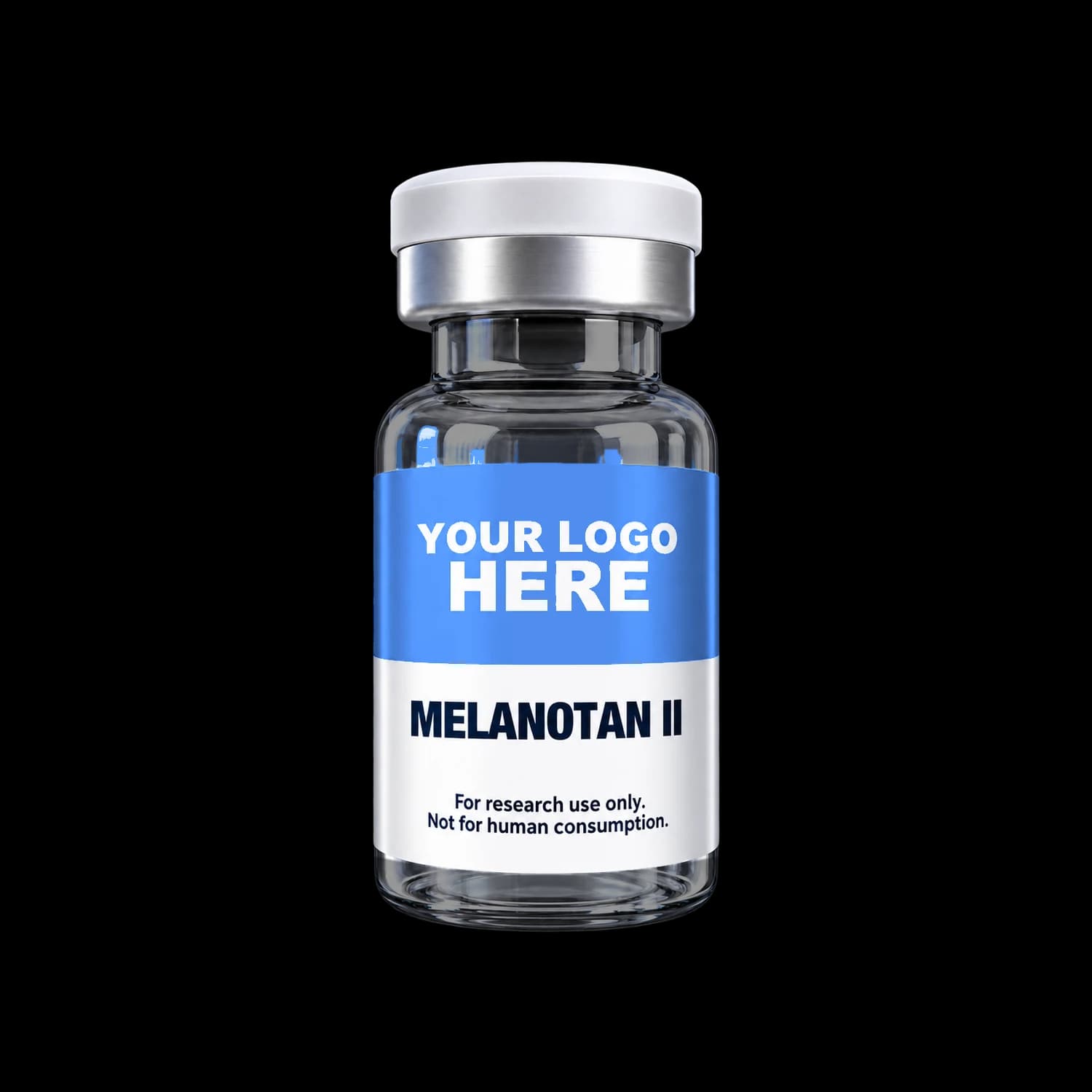
Wholesale Catalog
Available Doses
Published per-vial wholesale pricing for Melanotan II. Sold in kits of 10 vials with a 3-kit (30-vial) order minimum, mix and match across doses and compounds; lower prices apply at 10 kits and at 1,000+ vials in the order. Contact us for larger or custom-volume quotes — answered the same day. Urgent? Text or call (714) 625-9215 — you’ll reach a real person in the United States, not a chatbot or an overseas call center.
Melanotan II 10mg
WPSMT210 · CAS 121062-08-6 · Melanocortin
- 1–9 kits
- $19.41/vial$17.47 paying by card
- 10–99 kits
- $15.53/vial$13.97 paying by card
- 100+ kits
- $12.42/vial$11.18 paying by card
10% off with card Every product, every volume band — taken off at checkout when you choose card.
Sold in kits of 10 vials · 3-kit order minimum, mix and match · price set by the total kits in your order (BAC water not counted)
Questions? Text a rep or call (714) 625-9215 — a real person in the US answers.
Overview
Melanotan II is a synthetic cyclic heptapeptide analog of α-MSH acting as a nonselective melanocortin receptor agonist (MC1R, MC3R, MC4R, MC5R).
History
Developed at the University of Arizona in the early 1990s by Victor Hruby and colleagues.
Melanotan II and Melanotan I are not the same molecule
The names differ by one numeral and the two are confused constantly, but they are structurally and pharmacologically distinct.
Melanotan II is a cyclic heptapeptide — seven residues closed into a ring — and is a nonselective melanocortin agonist, active at MC1R, MC3R, MC4R and MC5R. Melanotan I (afamelanotide) is a linear 13-residue analogue, [Nle⁴, D-Phe⁷]-α-MSH, and is substantially MC1R-selective.
That selectivity difference is the whole reason both are stocked. A pigmentation or photoprotection model wanting MC1R engagement with as little off-target melanocortin activity as possible calls for Melanotan I. A model examining MC4R-mediated central or autonomic signalling calls for Melanotan II, because Melanotan I barely engages it.
Substituting one for the other does not change potency at a shared target — it changes which receptors are in play.
Handling
Melanotan II is cyclic, which makes it more conformationally constrained and generally more robust than a linear peptide of similar length. It ships lyophilised and reconstitutes readily in bacteriostatic or sterile water.
Lyophilised material is stored at -20°C and protected from light; reconstituted solution is refrigerated at 2-8°C and used within the study's defined window. These are general laboratory handling notes for a chemical reagent, not directions for human or veterinary use.
Melanotan II's lactam bridge and the 1989 Arizona ring-size study
Melanotan II is Ac-Nle-cyclo[Asp-His-D-Phe-Arg-Trp-Lys]-NH₂. Numbered against α-MSH it covers positions 4 to 10. It keeps the norleucine-4 and D-phenylalanine-7 substitutions of Melanotan I, then swaps Glu⁵ for aspartic acid and Gly¹⁰ for lysine. Those two side chains are joined by an amide — a lactam bridge — that closes a 23-membered ring around the His-D-Phe-Arg-Trp core.
The ring size was an experimental result, not an arbitrary choice. Al-Obeidi, de L. Castrucci, Hadley and Hruby (Journal of Medicinal Chemistry, 1989, 32:2555–2561) used molecular dynamics to design a series of side-chain-to-side-chain lactam analogues and tested seven of them in frog (Rana pipiens) and lizard (Anolis carolinensis) skin bioassays. Analogues with 23-membered rings were reported as roughly 100-fold more potent than α-MSH in the lizard assay and selective for lizard over frog melanocyte receptors; shifting the ring away from 23 atoms lost potency, and only the 23- and 24-membered rings showed prolonged residual activity.
That cyclization explains most of the practical contrasts with Melanotan I. Melanotan II has seven residues rather than thirteen, is conformationally constrained rather than freely flexible, and weighs 1,024.18 g/mol against 1,646.85.
Two reference tools built on the Melanotan II ring: SHU9119 and bremelanotide
Melanotan II matters to melanocortin research partly because two heavily used molecules were built on the same scaffold.
SHU9119 keeps the lactam ring and replaces D-phenylalanine at position 7 with D-2'-naphthylalanine. That one substitution converts the agonist into an antagonist at MC3R and MC4R. Fan, Boston, Kesterson, Hruby and Cone used the pair together in Nature in 1997 (385:165–168): in that work, Melanotan II delivered intracerebroventricularly inhibited feeding in four rodent models of hyperphagia, co-administered SHU9119 blocked that inhibition completely, and SHU9119 given alone increased nocturnal and post-fast feeding. The paper reported SHU9119 IC₅₀ values of 0.36 nM at MC4R and 4.5 nM at MC3R. The MTII/SHU9119 pair became a standard agonist–antagonist set in central melanocortin work.
Bremelanotide (PT-141) differs from Melanotan II at one atom-level detail: the C-terminal lysine ends in a free carboxylic acid rather than an amide. Cayman Chemical's product documentation gives its formal name as N-acetyl-L-norleucyl-L-α-aspartyl-L-histidyl-D-phenylalanyl-L-arginyl-L-tryptophyl-L-lysine (2→7)-lactam, formula C₅₀H₆₈N₁₄O₁₀, against C₅₀H₆₉N₁₅O₉ for Melanotan II. Bremelanotide was approved by the FDA as Vyleesi on 21 June 2019. Melanotan II itself has never been approved by any regulator, and the UK MHRA has warned publicly since 2008 that melanotan products offered online are unlicensed and that their safety, quality and effectiveness have not been verified. The first published human exposure to Melanotan II was a three-volunteer pilot study by Dorr et al. (Life Sciences, 1996, 58:1777–1784).
A lactam ring is not a disulfide: what that means at the bench
Cyclic peptides in a catalog like this one are closed in two quite different ways, and Melanotan II sits on the less fragile side of that split.
Its ring is a lactam — an amide bond between the Asp⁵ side-chain carboxyl and the Lys¹⁰ side-chain amine, chemically the same kind of bond as the peptide backbone itself. It is not a disulfide. Disulfide-closed peptides open under reducing conditions, so a reagent such as dithiothreitol or 2-mercaptoethanol in a buffer will linearize them; Melanotan II's ring is indifferent to those reagents, because there is no cysteine in the molecule to reduce. Its formula, C₅₀H₆₉N₁₅O₉, carries no sulfur at all.
That has two practical consequences. Redox-containing assay buffers that would compromise a disulfide-bridged peptide do not open this ring, and the constrained conformation the 1989 ring-size work selected for is retained under those conditions. The flip side is that the ring also cannot be opened deliberately as a control, so a linear comparator has to be a separately synthesized peptide rather than a reduced aliquot of the same vial.
Certificates of Analysis
1 certificate is on file for Melanotan II — open any one to read the full report.
| Lot / Lab | Dose | Tested | Purity | Certificate |
|---|---|---|---|---|
| 100057-0610Optiq Health LabsRP-HPLC / LC-MS | — | 2026-08-05 | — |
Key Areas of Research
- MC1R signaling, melanin synthesis
- MC4R-mediated central activity
- Autonomic and neuroendocrine pathways
References
- Hadley M.E., Dorr R.T. (2006). Peptides 27(4):921–925.
- Wessells H. et al. (2000). Int J Impot Res 12 Suppl 4:S74–79.
Melanotan II — Frequently Asked Questions
- What is Melanotan II?
- Melanotan II is a synthetic cyclic heptapeptide analog of α-MSH acting as a nonselective melanocortin receptor agonist (MC1R, MC3R, MC4R, MC5R).
- What is the CAS number for Melanotan II?
- The CAS number for Melanotan II is 121062-08-6. Its molecular formula is C₅₀H₆₉N₁₅O₉ (MW 1,024.18 g/mol).
- What doses of Melanotan II are available wholesale?
- Wholesale Peptide Supply stocks Melanotan II in 10mg. Wholesale pricing is provided by quote based on order volume, from a 3-kit (30-vial) order minimum, mix and match across doses and compounds.
- Is Melanotan II third-party tested?
- Yes. Every lot of Melanotan II is tested by an independent third-party laboratory, and a per-lot Certificate of Analysis is included with every order at no charge, issued in the name of Wholesale Peptide Supply. The most recent published lot, 100057-0610, was tested by Optiq Health Labs on 5 August 2026 by RP-HPLC / LC-MS. Every lot on file is listed with its certificate on this page.
- Is Melanotan II for human use?
- No. Melanotan II is sold strictly as a chemical reagent for in-vitro laboratory research and is not for human or veterinary use. Wholesale Peptide Supply is not a pharmacy or compounding facility.
- How do I get wholesale pricing for Melanotan II?
- Request a quote through our contact form or open a wholesale account. An account manager replies with volume pricing and lead times the same day. For anything urgent, text or call (714) 625-9215 to reach a real person in the US.
- Can I order Melanotan II in bulk?
- Yes. Melanotan II is available for bulk and wholesale orders, quoted by dose and volume, from a 3-kit (30-vial) order minimum, mix and match across doses and compounds, with lower prices at 10 kits and at 100 kits (1,000 vials) in the order. Submit the doses and quantities you need for a bulk quote.
- What is the structural difference between Melanotan II and PT-141 (bremelanotide)?
- Only the C-terminus. Both share the Ac-Nle-cyclo[Asp-His-D-Phe-Arg-Trp-Lys] lactam core, but Melanotan II ends in an amide and bremelanotide in a free acid, giving C₅₀H₆₉N₁₅O₉ against C₅₀H₆₈N₁₄O₁₀. The mass difference is about one dalton, so identity work has to resolve the two rather than infer one from an approximate mass. Both are stocked as separate catalog lines.
- Is Melanotan II active at all five melanocortin receptors?
- It is described as nonselective across MC1R, MC3R, MC4R and MC5R. MC2R, the adrenal receptor, is the exception in the family: it responds to ACTH rather than to α-MSH-derived sequences, so an α-MSH analogue is not the tool for MC2R work. "Nonselective" in the melanocortin literature therefore means four of the five subtypes.
- Which Melanotan II certificate is on file?
- The published certificate for Melanotan II is lot 100057-0610, tested by Optiq Health Labs on August 5, 2026, by RP-HPLC / LC-MS. That certificate does not print a vial strength, so the listing shows the lot without a dose rather than inferring one. The PDF itself is listed with the other certificates on this page.
- How many moles are in a 10 mg vial of Melanotan II?
- At the free-peptide molecular weight of 1,024.18 g/mol, 10 mg is about 9.76 µmol — compared with roughly 6.07 µmol for 10 mg of the 13-residue Melanotan I. Matching the two compounds by vial mass therefore does not give equimolar amounts, which matters in any receptor-selectivity comparison between them.
Related Compounds
Melanocortin
PT-141
PT-141 (Bremelanotide) is a synthetic α-MSH analog selective for central MC3R/MC4R activity, studied for neuroendocrine signaling and vascular pathways.
View details →Melanocortin
Oxytocin
Oxytocin is a cyclic nonapeptide synthesized in hypothalamic neurons. Through OXTR binding, it activates phospholipase C-mediated pathways. Studied for smooth muscle, CNS, and autonomic signaling.
View details →Melanocortin
Kisspeptin-10
Kisspeptin-10 is the decapeptide Tyr-Asn-Trp-Asn-Ser-Phe-Gly-Leu-Arg-Phe-NH₂, corresponding to the bioactive C-terminal residues 45-54 of metastin. It is studied as a KISS1R (GPR54) agonist in laboratory models of neuroendocrine signaling.
View details →Melanocortin
Melanotan I
Melanotan I (afamelanotide) is a 13-amino-acid analog of α-melanocyte stimulating hormone, [Nle⁴, D-Phe⁷]-α-MSH. It is studied as a melanocortin-1 receptor agonist in laboratory pigmentation and photoprotection models.
View details →Melanocortin
PT-141 Liquid Spray
PT-141 (Bremelanotide) supplied as an atomized solution in a metered spray bottle. A synthetic α-MSH analog selective for central MC3R/MC4R activity, supplied in solution rather than as a lyophilised solid.
View details →Melanocortin
MT-2 (Melanotan II) Liquid Spray
Melanotan II supplied as an atomized solution in a metered spray bottle — a cyclic α-MSH analog with broad melanocortin receptor activity.
View details →GLP-1 & Metabolic
Semaglutide
Semaglutide is a synthetic peptide analog that functions as a long-acting pathway agonist, structurally modified for extended half-life and improved target binding affinity. It is studied in preclinical and laboratory models for its ability to activate target pathways and modulate downstream molecular signaling associated with endocrine regulation.
View details →GLP-1 & Metabolic
Tirzepatide
Tirzepatide is a synthetic peptide that functions as a dual pathway agonist, designed as a once-weekly investigational compound studied in preclinical laboratory models for receptor-mediated signaling and modulation of downstream cascades.
View details →