Research Use Only. Oxytocin is sold as a chemical reagent for in-vitro laboratory research, not for human or veterinary use. It is not a drug, supplement, or compounded preparation. It must be handled by qualified professionals. Wholesale Peptide Supply is not a pharmacy or compounding facility under 503A or 503B.
Wholesale Oxytocin — Bulk Research Supply
Available sizes
In-stock orders ship same day when paid by 1 pm PT, Mon–Fri. Overnight available.
Buy Oxytocin wholesale and in bulk from a US-based research peptide supplier. Every lot is sourced in the USA and third-party tested, with the lab and method on each lot's certificate. Bulk Oxytocin is quoted by dose and volume from a 3-kit (30-vial) order minimum, mix and match across doses and compounds; lower prices are earned at 10 kits and again at 100 kits in the order, mix and match.
Oxytocin is a cyclic nonapeptide synthesized in hypothalamic neurons. Through OXTR binding, it activates phospholipase C-mediated pathways. Studied for smooth muscle, CNS, and autonomic signaling.
Wholesale Catalog
Available Doses
Published per-vial wholesale pricing for Oxytocin. Sold in kits of 10 vials with a 3-kit (30-vial) order minimum, mix and match across doses and compounds; lower prices apply at 10 kits and at 1,000+ vials in the order. Contact us for larger or custom-volume quotes — answered the same day. Urgent? Text or call (714) 625-9215 — you’ll reach a real person in the United States, not a chatbot or an overseas call center.
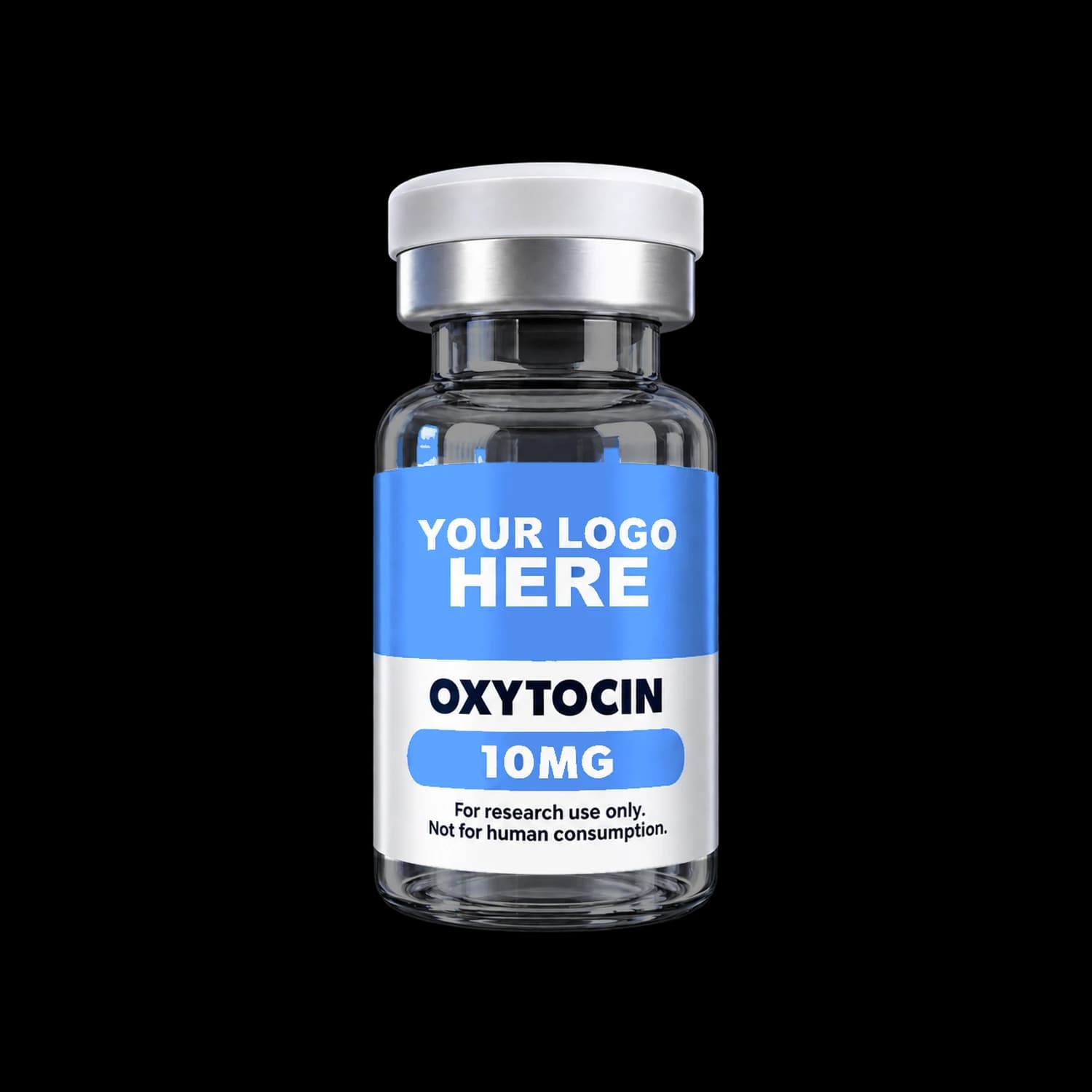
Oxytocin 10mg
WPSOT10 · CAS 50-56-6 · Melanocortin
- 1–9 kits
- $29.11/vial$26.20 paying by card
- 10–99 kits
- $23.29/vial$20.96 paying by card
- 100+ kits
- $18.63/vial$16.77 paying by card
10% off with card Every product, every volume band — taken off at checkout when you choose card.
Sold in kits of 10 vials · 3-kit order minimum, mix and match · price set by the total kits in your order (BAC water not counted)
Questions? Text a rep or call (714) 625-9215 — a real person in the US answers.
Overview
Oxytocin is a cyclic nonapeptide synthesized in hypothalamic neurons. Through OXTR binding, it activates phospholipase C-mediated pathways. Studied for smooth muscle, CNS, and autonomic signaling.
History
First isolated in 1906 by Henry Dale; sequence determined and synthesized by Vincent du Vigneaud in 1953 (Nobel Prize 1955).
A cyclic nonapeptide, and the disulfide that defines it
Oxytocin is a nine-residue peptide closed into a ring by a disulfide bridge between two cysteines, with a short tail extending from the ring. That cyclic topology is not incidental — it is what holds the molecule in the conformation OXTR recognises, and reducing the bridge does not weaken the compound so much as abolish the shape the research depends on.
In practical terms that rules out buffers containing reducing agents such as DTT or β-mercaptoethanol during preparation.
Signalling proceeds through OXTR, a G-protein-coupled receptor working via phospholipase C, which is why the same compound appears across smooth-muscle, central-nervous-system and autonomic research rather than in one narrow field. Its close structural relationship to vasopressin — the two differ at only two of nine positions — is a standard subject of receptor-selectivity work, and is worth knowing because cross-reactivity between the two systems is a real consideration in interpreting results.
Supplied lyophilised; stored at -20°C protected from light, reconstituted solution refrigerated at 2-8°C. General reagent handling only, not human or veterinary use instruction.
Oxytocin in solution: what Hawe et al. measured from pH 2 to pH 9
The most detailed public data on how oxytocin degrades comes from Hawe, Poole, Romeijn, Kasper, van der Heijden and Jiskoot at Leiden (Pharmaceutical Research, 2009). They held oxytocin at pH 2.0, 4.5, 7.0 and 9.0 and at 40, 55, 70 and 80°C, followed loss of the intact peptide by RP-HPLC, and identified the products by ESI-MS/MS.
Loss followed pseudo-first-order kinetics with Arrhenius temperature dependence. Degradation was fastest at pH 9.0, then 7.0, then 2.0, and slowest at pH 4.5, where the activation energy was highest at 116.3 kJ/mol. The pathways differed with pH. At pH 2.0 the main route was deamidation of oxytocin's three amide groups (Gln4, Asn5 and the C-terminal glycinamide). At pH 4.5 and above the products were dominated by the disulfide: tri- and tetrasulfide species, disulfide-linked and dityrosine-linked dimers, β-elimination products and larger aggregates. Two details follow from the sequence. Oxytocin has a single tyrosine, Tyr2, so every dityrosine dimer is cross-linked through that residue rather than through sulfur. And β-elimination at the Cys1–Cys6 cystine is the route that opens the ring itself.
For anyone characterizing reconstituted oxytocin, that list is effectively the impurity map: species at +32 Da (an extra sulfur), dimers near twice the parent mass, and deamidation (+1 Da) under acidic conditions. The finished pharmaceutical shows the same priorities. The US Pitocin label describes a solution buffered with acetic acid to a target pH of 3.5 that may contain up to 16% total impurities.
Oxytocin's cold-chain problem and the carbetocin redesign
Oxytocin's heat sensitivity has shaped a whole line of analog chemistry. Carbetocin, (2-O-methyltyrosine)-deamino-1-carba-oxytocin (C₄₅H₆₉N₁₁O₁₂S), removes the N-terminal amino group and replaces one sulfur of the disulfide with a CH₂ group, turning the bridge into a thioether. Those two edits take away the sites attacked by aminopeptidases and disulfidases, and they remove the S–S bond that Hawe et al. found at the center of oxytocin's degradation at neutral pH.
The practical stakes were tested in the WHO CHAMPION trial (Widmer et al., New England Journal of Medicine, 2018). Its background states that oxytocin requires cold storage that is not available in many countries. The trial randomized 29,645 participants at 23 sites in 10 countries to a heat-stable carbetocin formulation or oxytocin, with both kept at 2 to 8°C to preserve blinding. For research use the lesson is narrower: native oxytocin, unlike its carba analog, is limited by its disulfide, and storage conditions should be chosen with that in mind.
The enzyme that carbetocin's deamination guards against is named after oxytocin. Leucyl-cystinyl aminopeptidase (LNPEP; UniProt Q9UIQ6) is also called oxytocinase, placental leucine aminopeptidase and insulin-regulated aminopeptidase (IRAP). It removes N-terminal residues, cleaving before cysteine among others, and degrades oxytocin and vasopressin. The antagonist side of the family went the same way: atosiban, authorized in the EU as Tractocile, is a desamino-oxytocin analog that acts as a competitive vasopressin/oxytocin receptor antagonist.
Key Areas of Research
- OXTR-mediated signaling
- CNS behavioral pathways
- Autonomic and cardiac dynamics
References
- Du Vigneaud V. et al. (1953). J Am Chem Soc 75:4879–4880.
- Gimpl G., Fahrenholz F. (2001). Physiol Rev 81(2):629–683.
Oxytocin — Frequently Asked Questions
- What is Oxytocin?
- Oxytocin is a cyclic nonapeptide synthesized in hypothalamic neurons. Through OXTR binding, it activates phospholipase C-mediated pathways. Studied for smooth muscle, CNS, and autonomic signaling.
- What is the CAS number for Oxytocin?
- The CAS number for Oxytocin is 50-56-6. Its molecular formula is C₄₃H₆₆N₁₂O₁₂S₂ (MW 1,007.19 g/mol).
- What doses of Oxytocin are available wholesale?
- Wholesale Peptide Supply stocks Oxytocin in 10mg. Wholesale pricing is provided by quote based on order volume, from a 3-kit (30-vial) order minimum, mix and match across doses and compounds.
- Is Oxytocin third-party tested?
- Yes. Every lot of Oxytocin is tested by an independent third-party laboratory, and a per-lot Certificate of Analysis documenting identity and purity is included with every order at no charge, issued in the name of Wholesale Peptide Supply.
- Is Oxytocin for human use?
- No. Oxytocin is sold strictly as a chemical reagent for in-vitro laboratory research and is not for human or veterinary use. Wholesale Peptide Supply is not a pharmacy or compounding facility.
- How do I get wholesale pricing for Oxytocin?
- Request a quote through our contact form or open a wholesale account. An account manager replies with volume pricing and lead times the same day. For anything urgent, text or call (714) 625-9215 to reach a real person in the US.
- Can I order Oxytocin in bulk?
- Yes. Oxytocin is available for bulk and wholesale orders, quoted by dose and volume, from a 3-kit (30-vial) order minimum, mix and match across doses and compounds, with lower prices at 10 kits and at 100 kits (1,000 vials) in the order. Submit the doses and quantities you need for a bulk quote.
- Which residues differ between oxytocin and vasopressin?
- Positions 3 and 8. Oxytocin is Cys-Tyr-Ile-Gln-Asn-Cys-Pro-Leu-Gly-NH₂, and arginine vasopressin is Cys-Tyr-Phe-Gln-Asn-Cys-Pro-Arg-Gly-NH₂. Both close a Cys1–Cys6 disulfide ring and end in glycinamide. The US Pitocin label notes that the drug is made synthetically to avoid contamination with vasopressin, which co-occurs in pituitary extracts.
- What is the half-life of oxytocin?
- In plasma it is short: the FDA-approved Pitocin label gives about 1 to 6 minutes. In solution, stability depends strongly on pH. Hawe et al. (Pharm Res, 2009) found the slowest degradation at pH 4.5 among the four pH values tested (2.0, 4.5, 7.0 and 9.0) and the fastest at pH 9.0.
- Why are pharmaceutical oxytocin products labeled in units, while this is sold as 10 mg?
- Pharmacopeial oxytocin injections are standardized by biological activity. Pitocin, for example, is standardized to 10 USP units of oxytocic hormone per mL. A research reagent is quantified by mass instead, here 10 mg per vial. Converting between the two depends on the reference standard used, so the figures should not be treated as interchangeable.
- When was the oxytocin receptor cloned?
- Kimura, Tanizawa, Mori, Brownstein and Okayama reported the human oxytocin receptor in Nature in 1992. They identified it by expression cloning, and in Xenopus oocytes it responded specifically to oxytocin with an inward membrane current. The abstract describes a 388-amino-acid, seven-transmembrane G-protein-coupled receptor; the current UniProt entry (P30559) lists 389 residues.
Related Compounds
Melanocortin
Melanotan II
Melanotan II is a synthetic cyclic heptapeptide analog of α-MSH acting as a nonselective melanocortin receptor agonist (MC1R, MC3R, MC4R, MC5R).
View details →Melanocortin
PT-141
PT-141 (Bremelanotide) is a synthetic α-MSH analog selective for central MC3R/MC4R activity, studied for neuroendocrine signaling and vascular pathways.
View details →Melanocortin
Kisspeptin-10
Kisspeptin-10 is the decapeptide Tyr-Asn-Trp-Asn-Ser-Phe-Gly-Leu-Arg-Phe-NH₂, corresponding to the bioactive C-terminal residues 45-54 of metastin. It is studied as a KISS1R (GPR54) agonist in laboratory models of neuroendocrine signaling.
View details →Melanocortin
Melanotan I
Melanotan I (afamelanotide) is a 13-amino-acid analog of α-melanocyte stimulating hormone, [Nle⁴, D-Phe⁷]-α-MSH. It is studied as a melanocortin-1 receptor agonist in laboratory pigmentation and photoprotection models.
View details →Melanocortin
PT-141 Liquid Spray
PT-141 (Bremelanotide) supplied as an atomized solution in a metered spray bottle. A synthetic α-MSH analog selective for central MC3R/MC4R activity, supplied in solution rather than as a lyophilised solid.
View details →Melanocortin
MT-2 (Melanotan II) Liquid Spray
Melanotan II supplied as an atomized solution in a metered spray bottle — a cyclic α-MSH analog with broad melanocortin receptor activity.
View details →GLP-1 & Metabolic
Semaglutide
Semaglutide is a synthetic peptide analog that functions as a long-acting pathway agonist, structurally modified for extended half-life and improved target binding affinity. It is studied in preclinical and laboratory models for its ability to activate target pathways and modulate downstream molecular signaling associated with endocrine regulation.
View details →GLP-1 & Metabolic
Tirzepatide
Tirzepatide is a synthetic peptide that functions as a dual pathway agonist, designed as a once-weekly investigational compound studied in preclinical laboratory models for receptor-mediated signaling and modulation of downstream cascades.
View details →