Research Use Only. Cartalax is sold as a chemical reagent for in-vitro laboratory research, not for human or veterinary use. It is not a drug, supplement, or compounded preparation. It must be handled by qualified professionals. Wholesale Peptide Supply is not a pharmacy or compounding facility under 503A or 503B.
Wholesale Cartalax — Bulk Research Supply
Buy Cartalax wholesale and in bulk from a US-based research peptide supplier. Every lot is sourced in the USA and third-party tested, with the lab and method on each lot's certificate. Bulk Cartalax is quoted by dose and volume from a 3-kit (30-vial) order minimum, mix and match across doses and compounds; lower prices are earned at 10 kits and again at 100 kits in the order, mix and match.
Cartalax is a short synthetic peptide from the Khavinson bioregulator series, reported as the tripeptide Ala-Glu-Asp. It is studied in laboratory models of connective tissue and cartilage matrix signaling.
Wholesale Catalog
Available Doses
Published per-vial wholesale pricing for Cartalax. Sold in kits of 10 vials with a 3-kit (30-vial) order minimum, mix and match across doses and compounds; lower prices apply at 10 kits and at 1,000+ vials in the order. Contact us for larger or custom-volume quotes — answered the same day. Urgent? Text or call (714) 625-9215 — you’ll reach a real person in the United States, not a chatbot or an overseas call center.
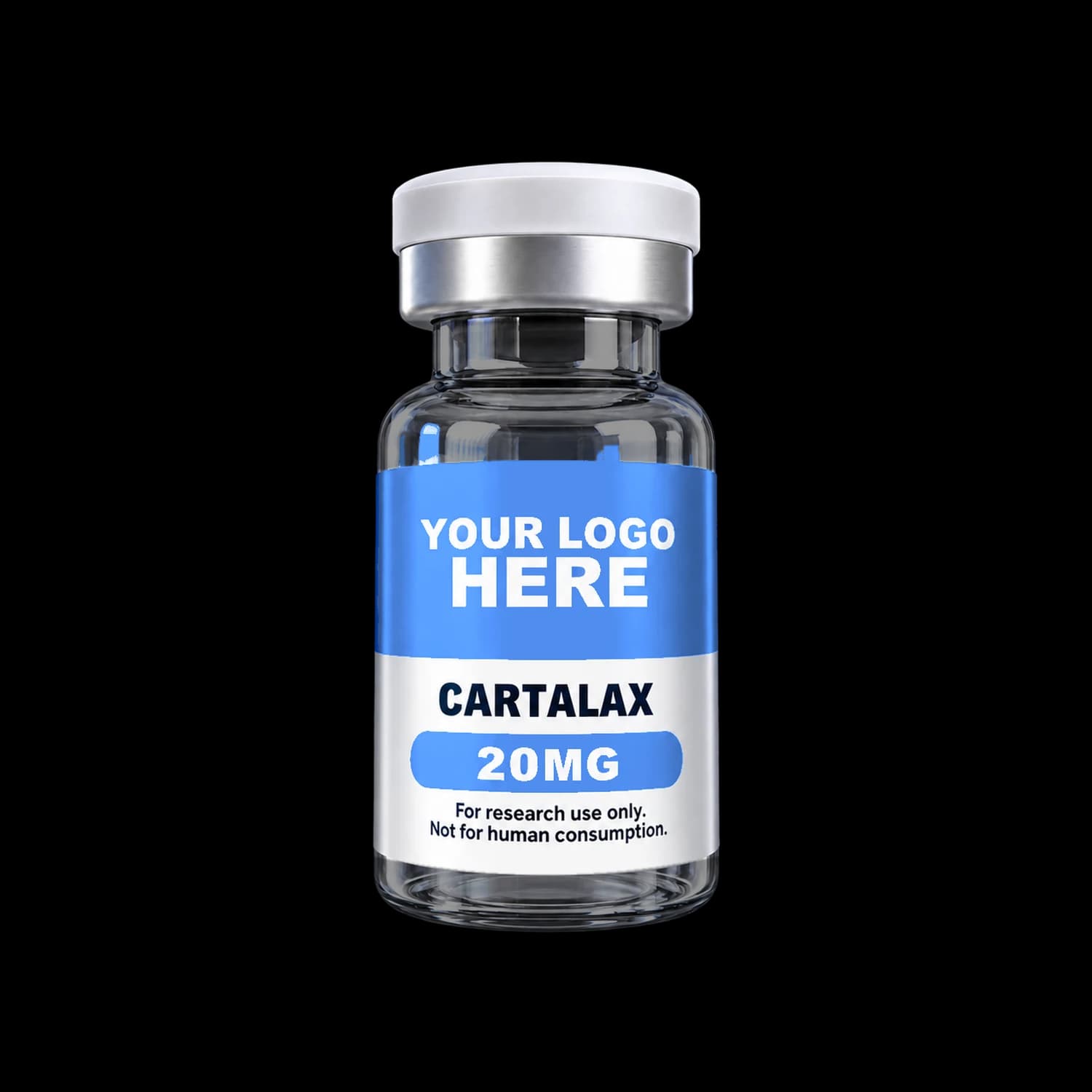
Cartalax 20mg
WPSCTL20 · CAS — · Cellular & Mitochondrial Peptides
Discontinued
This product is no longer stocked and is not being restocked.
Questions? Text a rep or call (714) 625-9215 — a real person in the US answers.
Overview
Cartalax is a short synthetic peptide from the Khavinson bioregulator series, reported as the tripeptide Ala-Glu-Asp. It is studied in laboratory models of connective tissue and cartilage matrix signaling.
History
Developed within the peptide bioregulator program at the St. Petersburg Institute of Bioregulation and Gerontology, which produced a family of short peptides each associated with a specific tissue in the published Russian literature.
Cartalax among the Khavinson short peptides
This catalogue stocks three peptides from the Khavinson bioregulator series, and their sequences are short enough that the relationships between them are worth setting out.
Cartalax is reported as the tripeptide Ala-Glu-Asp (AED). Epithalon is the tetrapeptide Ala-Glu-Asp-Gly (AEDG) — the same three residues with a glycine added. Pinealon is Glu-Asp-Arg (EDR), a different sequence again.
So Cartalax and Epithalon overlap substantially while Pinealon does not, and comparative work across the series is a standard way of probing how much of the reported activity tracks with sequence length versus composition. At three and four residues these are short enough that a single residue is a large proportion of the molecule.
Cartalax specifically is studied in connective tissue and cartilage matrix models, which is where it separates from the others in the series by application rather than by chemistry.
Handling
At tripeptide scale Cartalax dissolves readily in bacteriostatic or sterile water and is among the more robust compounds in the catalogue — the shear and foaming problems that affect multi-kilodalton peptides do not apply.
Identity confirmation matters more than usual on the short bioregulators precisely because they are short: three-residue sequences are easy to synthesise and correspondingly easy to mis-specify, and mass alone distinguishes them poorly. The per-lot Certificate of Analysis documents identity and purity for exactly this reason.
Lyophilised material is stored at -20°C protected from light; reconstituted solution is refrigerated at 2-8°C. General reagent handling guidance only.
Cartalax is AED: what the originating group's own papers say
Online listings disagree on whether Cartalax is the tripeptide Ala-Glu-Asp (AED) or the tetrapeptide Ala-Glu-Asp-Gly (AEDG), which is Epithalon. The group that developed it answers the question directly. A 2023 review from the St. Petersburg Institute of Bioregulation and Gerontology (Myakisheva, Linkova, Kozhevnikova and Ryzhak, Advances in Gerontology 36(3):313–323) names "the AED tripeptide (Kartalax)" and discusses it alongside Sigumir, a polypeptide complex from cartilage and bone tissue. Kartalax is a transliteration of the same Russian name.
Earlier papers from the same circle sometimes use a laboratory code instead: a 2015 kidney-culture study (Chalisova et al., Bulletin of Experimental Biology and Medicine 159:124–127) refers to "T-31 (AED)". For the free tripeptide, PubChem gives the formula C₁₂H₁₉N₃O₈ and a molecular weight of 333.29 g/mol (CID 87815447), which is 57 g/mol (one glycine residue) lighter than Epithalon.
The institute was founded in 1992 by Vladimir Khavinson (1946–2024), who directed it, and Cartalax is one of a series of short peptides from that program that each carry a tissue association in the Russian literature. For Cartalax, that association is cartilage.
What the published AED studies measured, model by model
Cartilage: in replicatively aged human mesenchymal stem cells, Myakisheva et al. (Advances in Gerontology, 2023, 36(3):383–390) reported that AED at 200 ng/mL increased gene expression and protein synthesis of the chondrogenic markers SOX9, aggrecan, type II collagen and COMP, an effect the cartilage polypeptide complex reached at 2,000 ng/mL. For a 333 g/mol tripeptide, 200 ng/mL works out to about 0.6 µM. A companion study (36(2):234–238) characterized the aging-associated secretory phenotype of chondrocytes (higher p16, p21, p53, TNF-α and IL-1α, lower Sirt1) and reported that AED and the complex shifted those markers back toward baseline.
Other cell models: in human fetal bone-marrow mesenchymal stem cells, Ashapkin et al. (Molecular Biology Reports, 2020) reported that AED, KED and KE at nanomolar concentrations raised IGF1 expression 3.5- to 5.6-fold and stimulated NFκB gene expression. In aging skin fibroblasts, Lin'kova et al. (Bulletin of Experimental Biology and Medicine, 2016) found that AED, among four short peptides tested, inhibited MMP-9 synthesis, and that AED and AEDG suppressed caspase-dependent apoptosis. In renal cell cultures, Khavinson et al. (Advances in Gerontology, 2014) reported effects of AED and EDL on p16, p21, p53 and SIRT-6 expression, with docking models placing both peptides in the DNA minor groove.
Almost all of this literature comes from Khavinson's institute and its collaborators, several papers are in Russian, and independent replication is limited. The findings are best read as one group's in-vitro results.
Key Areas of Research
- Connective tissue and cartilage matrix models
- Short-peptide gene-regulatory research
- Comparative studies across the Khavinson bioregulator series
References
- Khavinson V.K. (2002). Peptides and ageing. Neuroendocrinol Lett, 23(Suppl 3):11–144.
- Khavinson V.K. & Malinin V.V. (2005). Gerontological Aspects of Genome Peptide Regulation. Karger.
Cartalax — Frequently Asked Questions
- What is Cartalax?
- Cartalax is a short synthetic peptide from the Khavinson bioregulator series, reported as the tripeptide Ala-Glu-Asp. It is studied in laboratory models of connective tissue and cartilage matrix signaling.
- What doses of Cartalax are available wholesale?
- Wholesale Peptide Supply stocks Cartalax in 20mg. Wholesale pricing is provided by quote based on order volume, from a 3-kit (30-vial) order minimum, mix and match across doses and compounds.
- Is Cartalax third-party tested?
- Yes. Every lot of Cartalax is tested by an independent third-party laboratory, and a per-lot Certificate of Analysis documenting identity and purity is included with every order at no charge, issued in the name of Wholesale Peptide Supply.
- Is Cartalax for human use?
- No. Cartalax is sold strictly as a chemical reagent for in-vitro laboratory research and is not for human or veterinary use. Wholesale Peptide Supply is not a pharmacy or compounding facility.
- How do I get wholesale pricing for Cartalax?
- Request a quote through our contact form or open a wholesale account. An account manager replies with volume pricing and lead times the same day. For anything urgent, text or call (714) 625-9215 to reach a real person in the US.
- Can I order Cartalax in bulk?
- Yes. Cartalax is available for bulk and wholesale orders, quoted by dose and volume, from a 3-kit (30-vial) order minimum, mix and match across doses and compounds, with lower prices at 10 kits and at 100 kits (1,000 vials) in the order. Submit the doses and quantities you need for a bulk quote.
- Is Cartalax Ala-Glu-Asp (AED) or Ala-Glu-Asp-Gly (AEDG)?
- AED. A 2023 review from the St. Petersburg Institute of Bioregulation and Gerontology identifies Cartalax (Kartalax) as the AED tripeptide. AEDG is Epithalon, a different peptide with one extra glycine; listings that give Cartalax the AEDG sequence have conflated the two.
- Are Kartalax and T-31 the same as Cartalax?
- Kartalax is an alternative transliteration of the same Russian name. T-31 is a laboratory code that some papers from the same research circle use for the AED tripeptide, for example a 2015 study in kidney tissue cultures by Chalisova and colleagues.
- What is the molecular formula and weight of Cartalax?
- For the free tripeptide H-Ala-Glu-Asp-OH, PubChem lists C₁₂H₁₉N₃O₈ and 333.29 g/mol (CID 87815447). With two acidic side chains and a free C-terminus and no basic side chain, AED carries a net negative charge at neutral pH, unlike Pinealon (Glu-Asp-Arg), whose arginine offsets part of that charge.
- How independent is the Cartalax research?
- Not very. Nearly every published AED study comes from Vladimir Khavinson's St. Petersburg institute or its co-authors, and several are published in Russian in Advances in Gerontology. The results are in-vitro and cell-culture findings from one research group and have seen little outside replication.
Related Compounds
Cellular & Mitochondrial Peptides
SS-31
SS-31 (Elamipretide) is a mitochondria-targeting tetrapeptide that selectively accumulates at the inner mitochondrial membrane and interacts with cardiolipin. Studied for effects on cristae architecture, ATP synthesis, and ROS modulation.
View details →Cellular & Mitochondrial Peptides
Epithalon
Epithalon (Ala-Glu-Asp-Gly) is a synthetic tetrapeptide derived from epithalamin, studied for telomere dynamics, pineal gland regulation, and circadian signaling.
View details →Cellular & Mitochondrial Peptides
NAD+
NAD⁺ is a coenzyme central to redox reactions and bioenergetic processes, studied for its role in mitochondrial function, sirtuin activation, and PARP signaling.
View details →Cellular & Mitochondrial Peptides
GHK-Cu
GHK-Cu is a naturally occurring copper-binding tripeptide studied for its role in molecular signaling, matrix remodeling, and pathway dynamics.
View details →Cellular & Mitochondrial Peptides
MOTS-C
MOTS-c is a mitochondria-derived peptide studied for its role in AMPK pathway activation, mitochondrial-nuclear signaling, and systemic metabolic regulation.
View details →Cellular & Mitochondrial Peptides
L-Glutathione
L-Glutathione is a tripeptide serving as the primary intracellular antioxidant and redox regulator. Studied for ROS neutralization, redox homeostasis, and cellular integrity.
View details →Cellular & Mitochondrial Peptides
5-Amino-1-MQ
5-Amino-1-MQ is a small molecule inhibitor of nicotinamide N-methyltransferase (NNMT), affecting NAD+ and SAM availability and methylation capacity.
View details →Cellular & Mitochondrial Peptides
AHK-Cu
AHK-Cu (copper tripeptide-3) is the tripeptide Ala-His-Lys complexed with a copper(II) ion. It is studied alongside GHK-Cu in laboratory models of matrix signaling, follicular biology and vascular dynamics.
View details →