Research Use Only. HGH Fragment 176-191 is sold as a chemical reagent for in-vitro laboratory research. It is not a drug, supplement, or compounded preparation, and it is not for human or veterinary use. It must be handled by qualified professionals. Wholesale Peptide Supply is not a pharmacy or compounding facility under 503A or 503B.
Wholesale HGH Fragment 176-191 — Bulk Research Supply
Buy HGH Fragment 176-191 wholesale and in bulk from a US-based research peptide supplier. Every lot is sourced in the USA and third-party tested via HPLC/MS. Bulk HGH Fragment 176-191 is quoted by dose and volume from a 100-vial mix-and-match minimum; volume pricing is earned per compound at 100 kits.
HGH Fragment 176-191 is the C-terminal 16-residue fragment of human growth hormone, carrying an intramolecular disulfide bridge. It is studied in laboratory models of lipolytic signaling separated from the growth-promoting activity of the full hormone.
Wholesale Catalog
Available Doses
Published per-vial wholesale pricing for HGH Fragment 176-191. Sold in kits of 10 vials with a 100-vial order minimum you can mix and match across compounds; volume pricing applies at 1,000+ vials. Contact us for larger or custom-volume quotes — typically answered within 10 minutes during business hours.
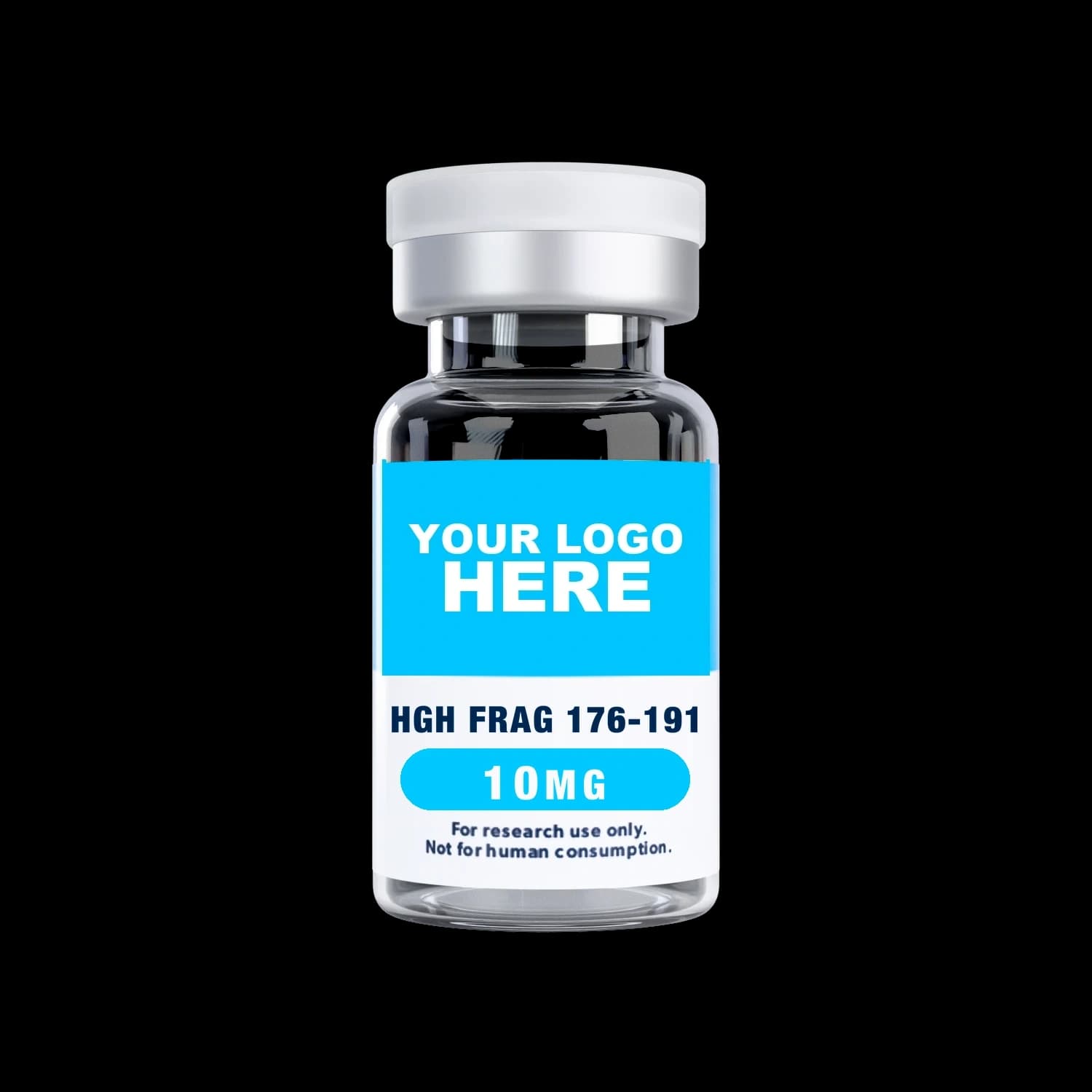
HGH Fragment 176-191 10mg50% off
WPSHF10 · CAS 66004-57-7 · GLP-1 & Metabolic
$25.88$12.94/vial · 50% off at any volumeWhile supplies last
Discontinued — limited to stock on hand. Once it's gone, it's gone. Sold in kits of 10 vials · 100-vial order minimum (mix & match across compounds).
Overview
HGH Fragment 176-191 is the C-terminal 16-residue fragment of human growth hormone, carrying an intramolecular disulfide bridge. It is studied in laboratory models of lipolytic signaling separated from the growth-promoting activity of the full hormone.
History
Identified as the region of the growth hormone sequence associated with lipolytic activity in the published literature, and used as the native-sequence reference point against which the tyrosine-substituted analog AOD-9604 is compared.
HGH Fragment 176-191 and AOD-9604
These two are the most closely related compounds in this part of the catalogue and are routinely compared in the literature, so the structural relationship is worth stating.
HGH Fragment 176-191 is the C-terminal 16-residue stretch of human growth hormone, carrying an intramolecular disulfide bridge. AOD-9604 is that same region with a tyrosine added at the N-terminus — a modification made to improve stability while leaving the active region intact.
Both exist for the same reason: to isolate the lipolytic signalling attributed to the hGH C-terminus from the growth-promoting activity of the full 191-residue hormone. That separation is the entire research rationale, and it is why structure-activity work on this region keeps returning to the pair.
Ordering one where a protocol specified the other changes the N-terminal modification, which is precisely the variable such comparisons are set up to test.
Handling and the disulfide bridge
The intramolecular disulfide bridge is the stability-critical feature of this fragment. Buffers containing reducing agents are generally avoided in preparation, since reducing the bridge changes the conformation the research depends on.
The compound ships lyophilised and is reconstituted with bacteriostatic or sterile water at a volume chosen to reach the assay's target concentration. At 16 residues it is more robust than the multi-kilodalton peptides in the catalogue, but the usual gentle handling still applies.
Lyophilised material is stored at -20°C protected from light; reconstituted solution is refrigerated at 2-8°C. General laboratory handling notes for a chemical reagent, not instructions for human or veterinary use.
Key Areas of Research
- Lipolytic pathway signaling
- Structure-activity work on the hGH C-terminus
- Comparative studies vs. AOD-9604
- Disulfide-bridge stability and handling
References
- Ng F.M. et al. (2000). Molecular and cellular actions of a structural domain of human growth hormone (AOD9401) on lipid metabolism. J Mol Endocrinol, 25(3):287–298.
- Heffernan M.A. et al. (2001). The effects of human GH and its lipolytic fragment (AOD9604) on lipid metabolism. Endocrinology, 142(12):5182–5189.
HGH Fragment 176-191 — Frequently Asked Questions
- What is HGH Fragment 176-191?
- HGH Fragment 176-191 is the C-terminal 16-residue fragment of human growth hormone, carrying an intramolecular disulfide bridge. It is studied in laboratory models of lipolytic signaling separated from the growth-promoting activity of the full hormone.
- What is the CAS number for HGH Fragment 176-191?
- The CAS number for HGH Fragment 176-191 is 66004-57-7. Its molecular formula is C₇₈H₁₂₃N₂₃O₂₂S₂ (MW 1,799.10 g/mol).
- What doses of HGH Fragment 176-191 are available wholesale?
- Wholesale Peptide Supply stocks HGH Fragment 176-191 in 10mg. Wholesale pricing is provided by quote based on order volume across 100–1,000 vials.
- Is HGH Fragment 176-191 third-party tested?
- Yes. Every lot of HGH Fragment 176-191 is tested by an independent third-party laboratory using HPLC/MS, and a per-lot Certificate of Analysis documenting identity and purity is included with every order at no charge, issued in the name of Wholesale Peptide Supply.
- Is HGH Fragment 176-191 for human use?
- No. HGH Fragment 176-191 is sold strictly as a chemical reagent for in-vitro laboratory research and is not for human or veterinary use. Wholesale Peptide Supply is not a pharmacy or compounding facility.
- How do I get wholesale pricing for HGH Fragment 176-191?
- Request a quote through our contact form or open a wholesale account. An account manager replies with volume pricing and lead times, typically within 10 minutes during business hours.
- Can I order HGH Fragment 176-191 in bulk?
- Yes. HGH Fragment 176-191 is available for bulk and wholesale orders, quoted by dose and volume, with the lower price earned per compound at 100 kits (1,000 vials). Submit the doses and quantities you need for a bulk quote.
Related Compounds
GLP-1 & Metabolic
Semaglutide
Semaglutide is a synthetic peptide analog that functions as a long-acting pathway agonist, structurally modified for extended half-life and improved target binding affinity. It is studied in preclinical and laboratory models for its ability to activate target pathways and modulate downstream molecular signaling associated with endocrine regulation.
View details →GLP-1 & Metabolic
Tirzepatide
Tirzepatide is a synthetic peptide that functions as a dual pathway agonist, designed as a once-weekly investigational compound studied in preclinical laboratory models for receptor-mediated signaling and modulation of downstream cascades.
View details →GLP-1 & Metabolic
Retatrutide
Retatrutide is a synthetic investigational peptide developed as a multi-pathway agonist, representing the next generation of metabolic research compounds. It activates multiple target receptor subtypes for broad systemic effects studied in preclinical models.
View details →GLP-1 & Metabolic
Cagrilintide
Cagrilintide is a synthetic, long-acting analog of amylin, studied for activation of target receptor pathways and characterization of endocrine and neuroendocrine signaling.
View details →GLP-1 & Metabolic
AOD-9604
AOD-9604 is a synthetic peptide fragment derived from the C-terminus of the somatotropin sequence, studied for its effects on lipolytic and anti-lipogenic pathways and β3-adrenergic signaling.
View details →GLP-1 & Metabolic
Triple Antagonist Liquid Spray
A combined metabolic research solution supplied as an atomized solution in a metered spray bottle. Composition is stated on the certificate of analysis for each lot.
View details →Growth Hormone
Ipamorelin
Ipamorelin is a synthetic pentapeptide and selective secretagogue-type agonist with minimal off-target pathway interference, used to study endocrine signaling and somatotroph axis modulation.
View details →Recovery & Structural
BPC-157
BPC-157 is a synthetic pentadecapeptide composed of 15 amino acids, originally derived from a naturally occurring protein fragment in gastric tissue. It has been studied extensively for its potential influence on molecular signaling, structural remodeling, and angiogenic processes.
View details →