Research Use Only. Dihexa is sold as a chemical reagent for in-vitro laboratory research, not for human or veterinary use. It is not a drug, supplement, or compounded preparation. It must be handled by qualified professionals. Wholesale Peptide Supply is not a pharmacy or compounding facility under 503A or 503B.
Wholesale Dihexa — Bulk Research Supply
Buy Dihexa wholesale and in bulk from a US-based research peptide supplier. Every lot is sourced in the USA and third-party tested, with the lab and method on each lot's certificate. Bulk Dihexa is quoted by dose and volume from a 3-kit (30-vial) order minimum, mix and match across doses and compounds; lower prices are earned at 10 kits and again at 100 kits in the order, mix and match.
Dihexa is a small-molecule angiotensin IV analog studied in laboratory models of hepatocyte growth factor / c-Met signaling and synaptic pathway activity.
Wholesale Catalog
Available Doses
Published per-vial wholesale pricing for Dihexa. Sold in kits of 10 vials with a 3-kit (30-vial) order minimum, mix and match across doses and compounds; lower prices apply at 10 kits and at 1,000+ vials in the order. Contact us for larger or custom-volume quotes — answered the same day. Urgent? Text or call (714) 625-9215 — you’ll reach a real person in the United States, not a chatbot or an overseas call center.
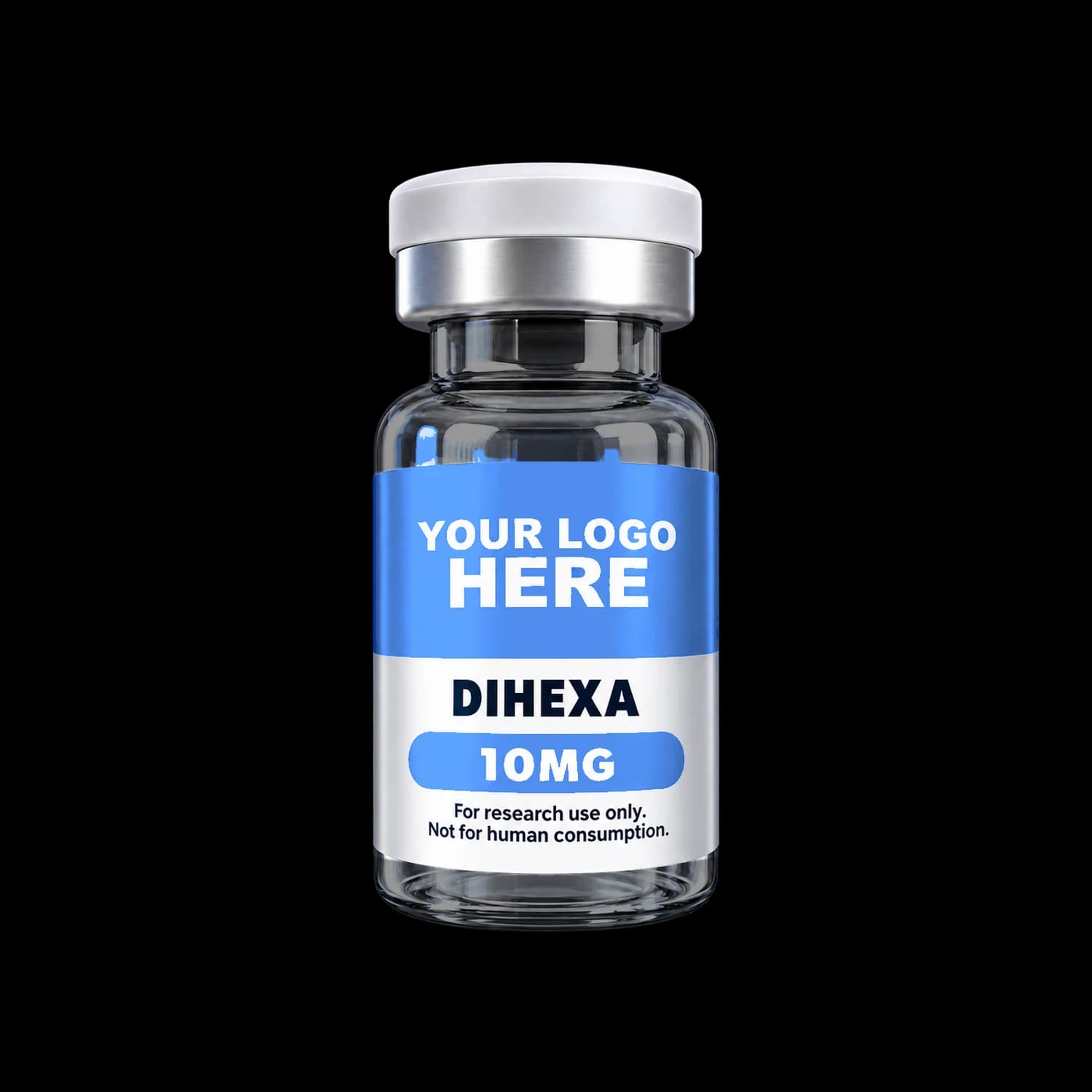
Dihexa 10mg
WPSDHX10 · CAS 1401708-83-5 · Neuropeptides
Discontinued
This product is no longer stocked and is not being restocked.
Questions? Text a rep or call (714) 625-9215 — a real person in the US answers.
Overview
Dihexa is a small-molecule angiotensin IV analog studied in laboratory models of hepatocyte growth factor / c-Met signaling and synaptic pathway activity.
History
Developed from the angiotensin IV fragment at Washington State University as an orally active, blood-brain-barrier-permeable analog, with published preclinical work centering on HGF/c-Met potentiation.
Not a peptide in the usual sense
Dihexa sits in a peptide catalogue but is better described as a small-molecule angiotensin IV analogue. That distinction has practical consequences for anyone handling it.
It was developed from the angiotensin IV scaffold with modifications aimed squarely at getting a molecule across the blood-brain barrier, which is the property most of the research interest rests on — a great many neuroactive peptides are ruled out of central models by permeability alone, and the design brief here was to avoid that.
Mechanistically it is studied in hepatocyte growth factor and c-Met receptor signalling, and in synaptogenesis models downstream of that pathway. Comparisons back to angiotensin IV itself are the standard way the literature separates scaffold effects from the modifications.
Because it is small and considerably more lipophilic than the peptides around it in this catalogue, solubility behaviour differs: it does not simply reconstitute in bacteriostatic water the way a lyophilised peptide cake does, and the solvent system should be chosen against the assay rather than assumed. General laboratory handling of a chemical reagent only, not human or veterinary use.
Dihexa's structure: what survives of angiotensin IV in N-hexanoic-Tyr-Ile-(6)-aminohexanoic amide
Angiotensin IV is the hexapeptide Val-Tyr-Ile-His-Pro-Phe, the C-terminal fragment of angiotensin II. Dihexa retains almost none of it. The chemical name is N-hexanoic-Tyr-Ile-(6)-aminohexanoic amide: a two-residue Tyr-Ile core, a six-carbon hexanoyl group capping the N-terminus, and a 6-aminohexanoic amide at the other end. McCoy et al. (J Pharmacol Exp Ther, 2013, 344:141–154) describe it as derived from the Nle-Tyr-Ile tripeptide core of norleucine¹-angiotensin IV, with later modifications that raised hydrophobicity and reduced hydrogen bonding.
Both caps are non-amino-acid fatty chains, which is why the molecule is formally C₂₇H₄₄N₄O₅ at 504.67 g/mol with only two peptide residues in it. The design purpose, as stated in that paper, was metabolic stabilization together with oral activity and blood-brain-barrier permeance.
The mechanistic literature sits in two places. Angiotensin IV's own binding site, the AT4 receptor, was identified by Albiston et al. (J Biol Chem, 2001, 276:48623–48626) as insulin-regulated aminopeptidase (IRAP), with AT4 ligands inhibiting IRAP's catalytic activity. Dihexa's published work instead centers on hepatocyte growth factor and its receptor c-Met. Comparisons back to angiotensin IV and to Nle¹-angiotensin IV are how the literature separates scaffold effects from the modifications.
What the dihexa literature actually consists of — including a retraction
Dihexa has no human clinical data. There are no published trials in people, no regulatory submission, no approval anywhere. Anyone reading vendor copy that implies otherwise is reading something the literature does not support. Everything published is preclinical, and the preclinical record is both small and partly compromised, which is worth stating plainly before any of it is cited.
The two most-cited primary papers both carry publisher notices. Benoist et al. (J Pharmacol Exp Ther, 2014, 351:390–402), the paper that attributed dihexa's reported effects to HGF/c-Met activation, received a Notice of Concern from the journal in 2021 (J Pharmacol Exp Ther 378:311) and was retracted in 2025 (retraction notice, J Pharmacol Exp Ther 392:103567). McCoy et al. (2013), the paper that introduced the molecule, received its own Notice of Concern in 2021 (J Pharmacol Exp Ther 378:313) and has not been retracted. The references on this page cite both; the notices are part of what a researcher needs to know about them.
Independent work exists outside that pair. Uribe, Kawas, Harding and Coffin (Front Cell Neurosci, 2015, 9:3) reported that in larval zebrafish lateral-line hair cells, 1 µM dihexa gave optimal protection against acute aminoglycoside exposure, that gentamicin uptake was unchanged, and that an HGF antagonist and Akt, TOR and MEK inhibitors reduced the effect. Weiss et al. (Ann Med Surg, 2021, 71:102917) tested dihexa at 2–4 mg/kg in a Lewis rat sciatic nerve transection-repair model, reporting improved walking-footprint grades mainly in combination with mesenchymal stem cells rather than for dihexa alone. Those are the sort of specific, bounded findings the compound is reasonably cited for.
Key Areas of Research
- HGF/c-Met receptor signaling
- Synaptogenesis research models
- Angiotensin IV pathway comparisons
- Blood-brain-barrier permeability of small peptides
References
- McCoy A.T. et al. (2013). Evaluation of metabolically stabilized angiotensin IV analogs as procognitive/antidementia agents. J Pharmacol Exp Ther, 344(1):141–154.
- Benoist C.C. et al. (2014). Hepatocyte growth factor mimetics. J Pharmacol Exp Ther, 351(2):390–402.
Dihexa — Frequently Asked Questions
- What is Dihexa?
- Dihexa is a small-molecule angiotensin IV analog studied in laboratory models of hepatocyte growth factor / c-Met signaling and synaptic pathway activity.
- What is the CAS number for Dihexa?
- The CAS number for Dihexa is 1401708-83-5. Its molecular formula is C₂₇H₄₄N₄O₅ (MW 504.67 g/mol).
- What doses of Dihexa are available wholesale?
- Wholesale Peptide Supply stocks Dihexa in 10mg. Wholesale pricing is provided by quote based on order volume, from a 3-kit (30-vial) order minimum, mix and match across doses and compounds.
- Is Dihexa third-party tested?
- Yes. Every lot of Dihexa is tested by an independent third-party laboratory, and a per-lot Certificate of Analysis documenting identity and purity is included with every order at no charge, issued in the name of Wholesale Peptide Supply.
- Is Dihexa for human use?
- No. Dihexa is sold strictly as a chemical reagent for in-vitro laboratory research and is not for human or veterinary use. Wholesale Peptide Supply is not a pharmacy or compounding facility.
- How do I get wholesale pricing for Dihexa?
- Request a quote through our contact form or open a wholesale account. An account manager replies with volume pricing and lead times the same day. For anything urgent, text or call (714) 625-9215 to reach a real person in the US.
- Can I order Dihexa in bulk?
- Yes. Dihexa is available for bulk and wholesale orders, quoted by dose and volume, from a 3-kit (30-vial) order minimum, mix and match across doses and compounds, with lower prices at 10 kits and at 100 kits (1,000 vials) in the order. Submit the doses and quantities you need for a bulk quote.
- How does dihexa differ from its parent, angiotensin IV?
- Almost completely, despite the lineage. Angiotensin IV is the natural hexapeptide Val-Tyr-Ile-His-Pro-Phe. Dihexa keeps a Tyr-Ile dipeptide core derived from the Nle-Tyr-Ile tripeptide of Nle¹-angiotensin IV, then caps it with a hexanoyl group and a 6-aminohexanoic amide — two fatty chains that are not amino acids. The result is a 504.67 g/mol small molecule designed for metabolic stability and lipophilicity, which is why it is handled more like a small-molecule reagent than like the lyophilized peptides beside it in this catalog.
- Is there any human data on dihexa?
- No. There are no published human clinical trials of dihexa, and it is not approved by any regulator. The published record is entirely preclinical — rodent and zebrafish models and in-vitro work — and two of its central papers carry journal notices (a 2021 Notice of Concern on McCoy et al. 2013, and a Notice of Concern followed by a 2025 retraction for Benoist et al. 2014). It is supplied strictly as a chemical reagent for in-vitro laboratory research.
- Why does dihexa not reconstitute like the other compounds here?
- Because it is not a lyophilized peptide cake. Its two fatty-acid caps make it markedly more lipophilic than a short hydrophilic peptide such as Semax or Selank, so bacteriostatic water is not a safe default solvent. The solvent system is chosen against the assay — and whatever vehicle is used has to be one the assay tolerates. This is general reagent-handling information, not an instruction for any other use.
- What does the 'dihexa' name refer to?
- The two six-carbon groups in the molecule: the N-terminal hexanoyl cap and the C-terminal 6-aminohexanoic amide — di-hexa. The development code PNB-0408 also appears in the literature for the same compound, CAS 1401708-83-5.
Related Compounds
Neuropeptides
Semax
Semax is a synthetic heptapeptide derived from ACTH 4-10 with a C-terminal Pro-Gly-Pro extension, studied for neuronal signaling, CNS pathway dynamics, and stress responses.
View details →Neuropeptides
Selank
Selank is a synthetic heptapeptide analog of tuftsin studied for neurotransmitter signaling, stress response, and immune signaling.
View details →Neuropeptides
DSIP
DSIP is a small amphiphilic nonapeptide with effects on circadian signaling and neuroendocrine regulation in experimental models.
View details →Neuropeptides
Pinealon
Pinealon is the synthetic tripeptide Glu-Asp-Arg (EDR), one of the short peptide bioregulators developed in Russian gerontology research. It is studied in laboratory models of neuronal signaling and oxidative stress response.
View details →GLP Series Peptides
GLP-1S
GLP-1S is a synthetic peptide analog that functions as a long-acting pathway agonist, structurally modified for extended half-life and improved target binding affinity. It is studied in preclinical and laboratory models for its ability to activate target pathways and modulate downstream molecular signaling associated with endocrine regulation.
View details →GLP Series Peptides
GLP-2T
GLP-2T is a synthetic peptide that functions as a dual pathway agonist, designed as a once-weekly investigational compound studied in preclinical laboratory models for receptor-mediated signaling and modulation of downstream cascades.
View details →GLP Series Peptides
GLP-3R
GLP-3R is a synthetic investigational peptide developed as a multi-pathway agonist, representing the next generation of metabolic research compounds. It activates multiple target receptor subtypes for broad systemic effects studied in preclinical models.
View details →Secretagogue Peptides
Ipamorelin
Ipamorelin is a synthetic pentapeptide and selective secretagogue-type agonist with minimal off-target pathway interference, used to study endocrine signaling and somatotroph axis modulation.
View details →