Research Use Only. GHRP-2 Acetate is sold as a chemical reagent for in-vitro laboratory research, not for human or veterinary use. It is not a drug, supplement, or compounded preparation. It must be handled by qualified professionals. Wholesale Peptide Supply is not a pharmacy or compounding facility under 503A or 503B.
Wholesale GHRP-2 Acetate — Bulk Research Supply
Also written GHRP 2 or GHRP2.
Buy GHRP-2 Acetate wholesale and in bulk from a US-based research peptide supplier. Every lot is sourced in the USA and third-party tested, with the lab and method on each lot's certificate. Bulk GHRP-2 Acetate is quoted by dose and volume from a 3-kit (30-vial) order minimum, mix and match across doses and compounds; lower prices are earned at 10 kits and again at 100 kits in the order, mix and match.
GHRP-2 (pralmorelin) is a synthetic hexapeptide growth hormone secretagogue with the sequence D-Ala-D-2Nal-Ala-Trp-D-Phe-Lys-NH₂, studied as a ghrelin receptor agonist in laboratory models.
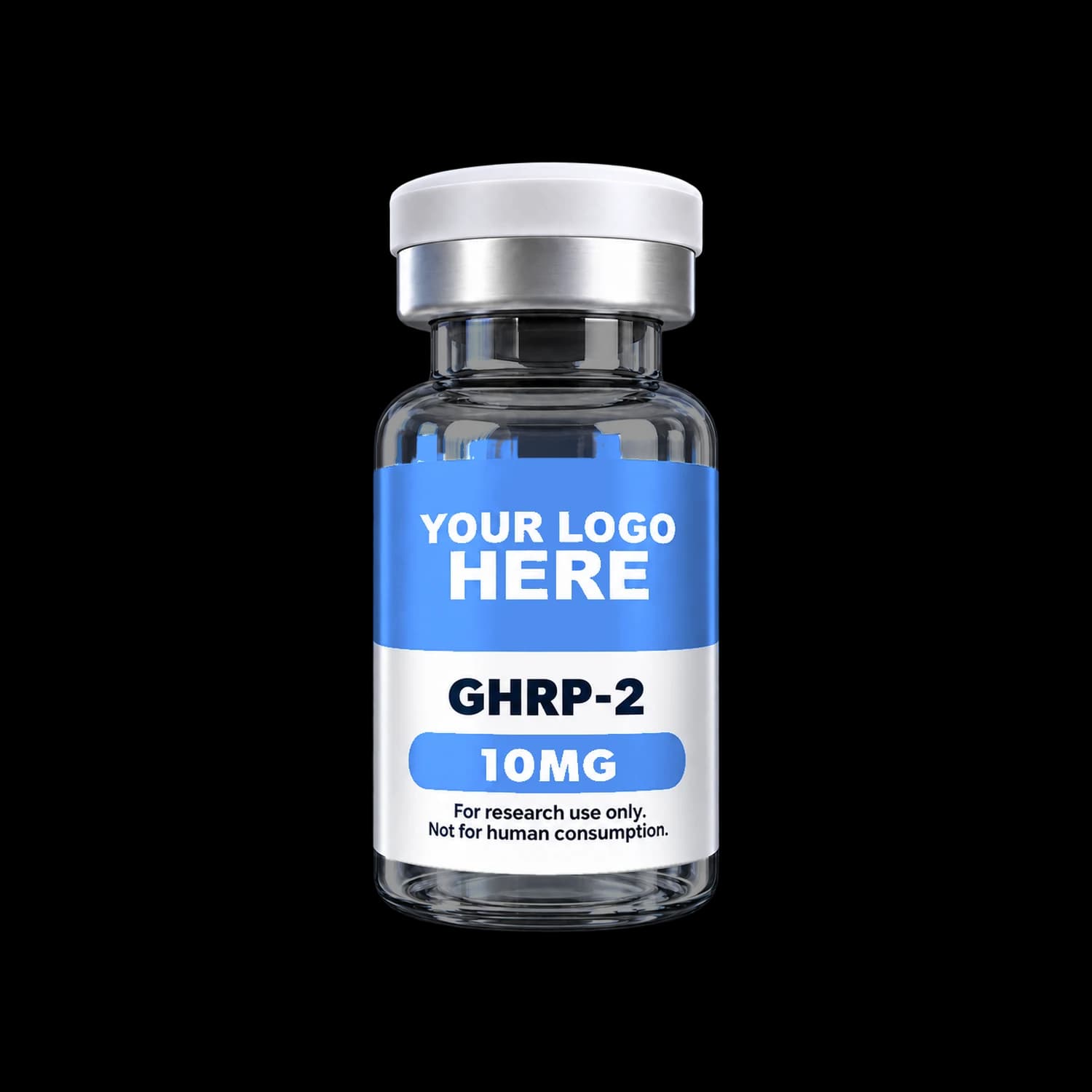
Wholesale Catalog
Available Doses
Published per-vial wholesale pricing for GHRP-2 Acetate. Sold in kits of 10 vials with a 3-kit (30-vial) order minimum, mix and match across doses and compounds; lower prices apply at 10 kits and at 1,000+ vials in the order. Contact us for larger or custom-volume quotes — answered the same day. Urgent? Text or call (714) 625-9215 — you’ll reach a real person in the United States, not a chatbot or an overseas call center.
GHRP-2 Acetate 10mg
WPSGP210 · CAS 158861-67-7 · Secretagogue Peptides
Discontinued
This product is no longer stocked and is not being restocked.
Questions? Text a rep or call (714) 625-9215 — a real person in the US answers.
Overview
GHRP-2 (pralmorelin) is a synthetic hexapeptide growth hormone secretagogue with the sequence D-Ala-D-2Nal-Ala-Trp-D-Phe-Lys-NH₂, studied as a ghrelin receptor agonist in laboratory models.
History
Developed from the growth hormone releasing peptide series that followed the characterization of GHRP-6, with structural changes intended to increase potency at the secretagogue receptor.
GHRP-2 and GHRP-6: choosing between them
Both are synthetic hexapeptide growth-hormone secretagogues acting at the ghrelin receptor, and both have been in laboratory use long enough to serve as reference compounds. They differ in sequence and, more usefully, in what each is normally chosen to model.
GHRP-2 (pralmorelin) carries D-Ala-D-2Nal-Ala-Trp-D-Phe-Lys-NH₂. In comparative secretagogue work it is the more potent of the two for growth-hormone release at equivalent concentration, which is why it tends to be selected when GH output is the readout itself.
GHRP-6 carries His-D-Trp-Ala-Trp-D-Phe-Lys-NH₂ and was the first of the series to be widely characterised. Its distinguishing feature in preclinical models is a pronounced food-intake response alongside GH release — and that appetite signalling is usually the reason it is chosen rather than a side effect of choosing it.
So the decision is rarely about which is stronger. It is whether the model wants GH release as cleanly as possible, or wants the ghrelin-receptor appetite response in the picture.
GHRP-2 (pralmorelin): from KP-102 to a Japanese diagnostic test
GHRP-2 is one of the few compounds in the secretagogue class that became an approved product. Under the nonproprietary name pralmorelin and the development code KP-102, it was taken forward by Kaken Pharmaceutical and launched in Japan as a diagnostic agent for growth hormone deficiency, sold as GHRP Kaken 100. KEGG files pralmorelin hydrochloride under Japan's therapeutic category 7223, diagnostic reagents for endocrine function, and lists only a Japanese product.
The validation work behind that use was published by Chihara and the KP-102 Study Group in the European Journal of Endocrinology in 2007. The study enrolled 77 healthy subjects and 58 patients already classified as GH-deficient by the insulin tolerance test. Peak GH after GHRP-2 came within 60 minutes in every subject, averaging 84.6 µg/L in the healthy group against 1.36 µg/L in patients. The authors proposed a 15 µg/L peak-GH cut-off, equivalent to 9 µg/L when GH is calibrated against the recombinant WHO 98/574 standard, and reported that it corresponded to the 3 µg/L threshold used with the insulin tolerance test.
For a laboratory, the practical point is that GHRP-2 has a published, standardized readout behind it: a defined time-to-peak and a calibrated threshold, which few research secretagogues can claim.
GHRP-2 beyond growth hormone: the ACTH, cortisol and prolactin data
GHRP-2 is not a clean GH-only stimulus, and the literature quantifies how far it strays. In a 1997 Peptides study from the University of Turin, Arvat and colleagues compared GHRP-2 and hexarelin with GHRH, TRH and human CRH in healthy young adults. GHRP-2 produced a GH response larger than GHRH, prolactin release lower than TRH, and ACTH and cortisol release similar in size to that produced by CRH itself.
The same off-target profile shows up across species. In Novo Nordisk's 1998 characterization of ipamorelin (Raun et al., European Journal of Endocrinology), conscious swine given GHRP-2 or GHRP-6 showed raised plasma ACTH and cortisol, while ipamorelin did not, even at more than 200 times its GH-releasing ED50. In that model GHRP-2 was the most potent of the three for GH (ED50 0.6 nmol/kg against 2.3 for ipamorelin and 3.9 for GHRP-6) but reached a lower maximal GH level.
That combination, highest potency with measurable adrenal-axis activity, is what distinguishes GHRP-2 within the catalog's secretagogues.
GHRP-2's signature metabolite: the D-Ala-D-2Nal-Ala tripeptide
Because GHRP-2 opens with two D-residues, D-Ala and D-3-(2-naphthyl)alanine, its N-terminal fragment survives metabolism intact. Okano and colleagues at the Mitsubishi Chemical Medience anti-doping center (Rapid Communications in Mass Spectrometry, 2010) built a UPLC-MS/MS method around that fragment, the tripeptide acid D-Ala-D-(β-naphthyl)-Ala-Ala-OH, designated AA-3, alongside intact GHRP-2. Using stable-isotope-labeled GHRP-2 as internal standard, both analytes were quantified at 0.5 to 10 ng/mL in urine with 84 to 101% recovery.
AA-3 is therefore the reference marker when a study needs to distinguish GHRP-2 exposure from parent-compound degradation, and it is specific to GHRP-2: the D-Ala-D-2Nal-Ala sequence occurs in neither GHRP-6 nor ipamorelin.
Key Areas of Research
- GHS-R1a receptor binding and selectivity
- Secretagogue signaling cascades
- Comparative studies vs. GHRP-6 and ipamorelin
- Cross-reactivity with cortisol and prolactin pathways
References
- Bowers C.Y. (1998). Growth hormone-releasing peptide (GHRP). Cell Mol Life Sci, 54(12):1316–1329.
- Pihoker C. et al. (1997). Diagnostic studies with intravenous and intranasal GHRP-2. J Endocrinol, 155(1):79–86.
GHRP-2 Acetate — Frequently Asked Questions
- What is GHRP-2 Acetate?
- GHRP-2 (pralmorelin) is a synthetic hexapeptide growth hormone secretagogue with the sequence D-Ala-D-2Nal-Ala-Trp-D-Phe-Lys-NH₂, studied as a ghrelin receptor agonist in laboratory models.
- What is the CAS number for GHRP-2 Acetate?
- The CAS number for GHRP-2 Acetate is 158861-67-7. Its molecular formula is C₄₅H₅₅N₉O₆ (MW 817.97 g/mol).
- What doses of GHRP-2 Acetate are available wholesale?
- Wholesale Peptide Supply stocks GHRP-2 Acetate in 10mg. Wholesale pricing is provided by quote based on order volume, from a 3-kit (30-vial) order minimum, mix and match across doses and compounds.
- Is GHRP-2 Acetate third-party tested?
- Yes. Every lot of GHRP-2 Acetate is tested by an independent third-party laboratory, and a per-lot Certificate of Analysis documenting identity and purity is included with every order at no charge, issued in the name of Wholesale Peptide Supply.
- Is GHRP-2 Acetate for human use?
- No. GHRP-2 Acetate is sold strictly as a chemical reagent for in-vitro laboratory research and is not for human or veterinary use. Wholesale Peptide Supply is not a pharmacy or compounding facility.
- How do I get wholesale pricing for GHRP-2 Acetate?
- Request a quote through our contact form or open a wholesale account. An account manager replies with volume pricing and lead times the same day. For anything urgent, text or call (714) 625-9215 to reach a real person in the US.
- Can I order GHRP-2 Acetate in bulk?
- Yes. GHRP-2 Acetate is available for bulk and wholesale orders, quoted by dose and volume, from a 3-kit (30-vial) order minimum, mix and match across doses and compounds, with lower prices at 10 kits and at 100 kits (1,000 vials) in the order. Submit the doses and quantities you need for a bulk quote.
- Is GHRP-2 the same compound as pralmorelin?
- Yes. Pralmorelin is the nonproprietary name for GHRP-2, and KP-102 was its development code. The Japanese diagnostic product is formulated as pralmorelin dihydrochloride (C₄₅H₅₅N₉O₆·2HCl, MW 890.89 per KEGG), whereas this catalog item is the acetate salt; the peptide itself, C₄₅H₅₅N₉O₆, is identical.
- What is the 2-Nal residue in GHRP-2, and how does its sequence differ from GHRP-6?
- 2-Nal is D-3-(2-naphthyl)alanine, a non-natural residue with a two-ring naphthalene side chain. GHRP-2 (D-Ala-D-2Nal-Ala-Trp-D-Phe-Lys-NH₂) replaces GHRP-6's N-terminal His with D-Ala and its D-Trp at position 2 with D-2Nal, keeping the Ala-Trp-D-Phe-Lys-NH₂ core. Arvat et al. (1997) described GHRP-2 and hexarelin as synthetic super-analogs of GHRP-6.
- How does GHRP-2 compare with ipamorelin in published data?
- In the 1998 swine study that introduced ipamorelin (Raun et al., Eur J Endocrinol), GHRP-2 was the more potent GH releaser (ED50 0.6 vs 2.3 nmol/kg) but reached a lower maximum GH level. GHRP-2 also raised plasma ACTH and cortisol, whereas ipamorelin did not at more than 200 times its ED50 for GH release. That difference is why ipamorelin was described as the first selective growth hormone secretagogue.
- Is GHRP-2 an approved drug anywhere?
- Only as a diagnostic. Pralmorelin was launched in Japan by Kaken Pharmaceutical as GHRP Kaken 100, a test agent for assessing growth hormone deficiency, and KEGG classifies it as a diagnostic reagent for endocrine function. The product sold here is a research reagent only, not for human or veterinary use.
Related Compounds
Secretagogue Peptides
Tesamorelin
Tesamorelin is a synthetic analog of growth hormone releasing hormone built on the full 44-residue GHRH sequence, carrying an N-terminal trans-3-hexenoyl modification that resists enzymatic cleavage and extends the window of GHRH receptor engagement relative to native GHRH.
View details →Secretagogue Peptides
Ipamorelin
Ipamorelin is a synthetic pentapeptide and selective secretagogue-type agonist with minimal off-target pathway interference, used to study endocrine signaling and somatotroph axis modulation.
View details →Secretagogue Peptides
CJC-1295 w/DAC
CJC-1295 with DAC is a modified GHRH analog with prolonged half-life through albumin binding, enabling sustained somatotroph axis activation in experimental models.
View details →Secretagogue Peptides
CJC/IPA No DAC Blend
Combines CJC-1295 No DAC with Ipamorelin to target two complementary signaling pathways. The No DAC variant maintains a shorter duration of action enabling pulsatile GH dynamics.
View details →Secretagogue Peptides
IGF-LR3
IGF-LR3 (Long Arg3 IGF-1) is a synthetic IGF-1 analog with reduced IGFBP binding and significantly extended half-life, used to investigate IGF-1 receptor-mediated signaling and metabolic regulation.
View details →Secretagogue Peptides
CJC-1295 (no DAC)
CJC-1295 without DAC — also called modified GRF (1-29) — is a GHRH analog carrying four amino acid substitutions that resist enzymatic cleavage, without the drug affinity complex that extends the DAC variant's half-life.
View details →Secretagogue Peptides
GHRP-6 Acetate
GHRP-6 is a synthetic hexapeptide growth hormone secretagogue with the sequence His-D-Trp-Ala-Trp-D-Phe-Lys-NH₂. It was the first of the GHRP series to be widely characterized and remains a common reference compound in secretagogue research.
View details →Secretagogue Peptides
HCG
Human chorionic gonadotropin is a glycoprotein hormone made of a 92-amino-acid α-chain shared with LH, FSH and TSH, and a distinct 145-residue β-chain. It is supplied as a laboratory reagent and quantified in international units rather than by mass.
View details →